Article
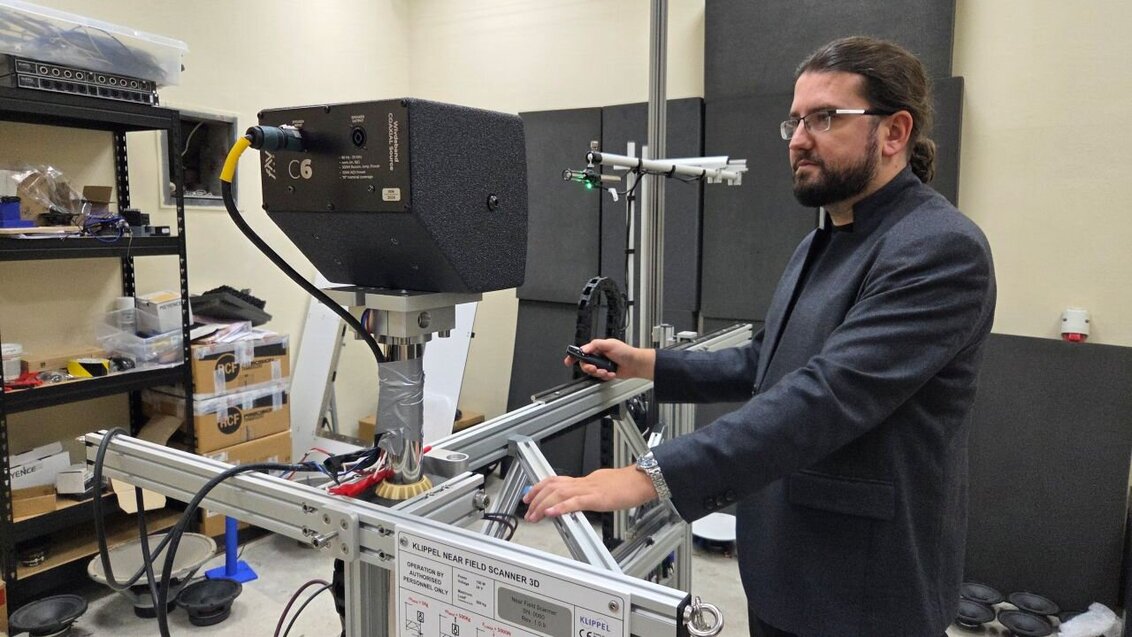
The Foundation for Polish Science (FNP) announced the results of the latest FIRST TEAM call. Among the 13 winning projects, two were from AGH University.
Metamaterial speaker diaphragms prototyped using additive manufacturing
Is it possible to design a speaker diaphragm whose internal structure allows for better control of how it vibrates and radiates sound? A team of researchers from the Faculty of Mechanical Engineering and Robotics will seek an answer to this question. Led by Dr Bartłomiej Chojnacki, the project will be carried out in collaboration with Pylon Audio and TU Dresden.
A diaphragm is one of the key components of any loudspeaker. Its geometry, stiffness, and mass determine the bandwidth and efficiency of the transducer. In conventional designs, the scope for shaping these properties is limited by the materials used and the manufacturing processes employed.
The researchers at AGH University aim to utilise vibroacoustic metamaterials, that is structures whose properties stem not only from the type of material but primarily from their carefully designed geometry. The diaphragms will feature local stiffeners, periodic structures, and resonant elements for precise vibration control.
Various 3D printing technologies will be used to produce prototypes, which will enable rapid testing of numerous design variants without the need to prepare costly production moulds. The project will combine numerical modelling, structural optimisation, additive manufacturing, and measurements of vibrations and electroacoustic parameters.
The purpose of the research is to develop new membrane designs that will allow us to control undesirable forms of vibration, broaden the operating bandwidth of the loudspeaker, and increase its efficiency. The results may be applied to both home audio systems and professional electroacoustic transducers.
FUN-AERO: FUNctionally graded superalloys for next-generation AEROspace applications
The aerospace industry is always on the lookout for materials capable of withstanding extreme loads and increasingly high temperatures inside engines. The FUN-AERO project addresses this particular challenge. The aim of the proposed research is to design, produce, and analyse the structure and properties of a new generation of advanced metal alloys, superalloys, using additive manufacturing, commonly known as 3D printing.
The project moves away from traditional processes, such as casting, in favour of producing gradient materials by directly remelting the feedstock using a laser beam. Metal powders are remelted and applied layer by layer. This allows for significantly greater control over the manufacturing process, the chemical composition, and the properties of the component. The research will use thermodynamic modelling to understand solidification processes and unlock the potential for the use of non-weldable superalloys in additive manufacturing processes. An innovative use of a chemical composition gradient will allow the researchers to tailor the properties of the material to operating conditions.
The development of innovative materials technologies is a key step towards creating more durable and lighter components designed to operate in extreme conditions.
At AGH University, the research will be conducted by Dr Sebastian Lach at the Centre of Electron Microscopy for Materials Science part of the Faculty of Metals Engineering and Industrial Computer Science. The project will be carried out in collaboration with researchers from the University of Sheffield and Cranfield University. Spaceform is the project’s industrial partner.
Gradient structure. Photograph: Sebastian Lech

About FIRST TEAM
Financed from the European Funds for Smart Economy (FENG), FIRST TEAM offers funding for setting up a research team and conducting innovative research with application potential in Poland. A total of 102 applications were submitted in this call for proposals, of which 13 projects were awarded funding.
 Perła finishes second in European solar car challenge
  Two AGH University projects with FIRST TEAM grant
  AGH Solar Plane comes fifth in SUAS 2026
  The future of technical universities and quality of education in focus at AGH University
  Academia and industry unite for AI: establishment of CESAR
  Join the Autumn School on Technologies for Space Medicine

