Article

Looking back at 2025 at AGH University we can proudly say that it was straight out of space! What made it so special? Read our overview of space-related events that sparked a lot of interest over the last 12 months.
A new faculty, an experiment on the ISS, and a Polish astronaut at AGH University
In early April, AGH University opened the Faculty of Space Technologies, the first such faculty in Poland and one of the very few in Europe. The university’s 18th faculty educates students in the dynamically growing space sector, offering a master’s in English in Space Engineering. The field of study includes three specialisations, and classes are held by subject-matter experts and employees of space agencies and tech companies.
At the end of June, an experiment developed in the AGH University Space Technology Centre was taken to the International Space Station (ISS). Implemented by a team from the Faculty of Space Technologies, the project consisted in the design of a wristband made of an ultrathin material called MXene. The official name of the experiment, MXene in LEO, refers to Low Earth Orbit. The research was one of 13 experiments in technology, biology, medicine, and psychology prepared by Polish scientists with the Axiom Mission 4 in mind. The technological and scientific part of the mission was called IGNIS.
The MXene band was tested by the Polish project astronaut of the European Space Agency, Dr Sławosz Uznański-Wiśniewski, the first Pole to be on the ISS. We continue to wait for the results of the experiment, but the testing stage was successful. In the future, MXene bands developed at AGH University might not only monitor the vital signs of astronauts but also help patients here on Earth.
In November, Dr Sławosz Uznański-Wiśniewski came to AGH University as part of the mission IGNIS Post-Flight Tour to speak about preparations for and the course of Axiom 4. To listen to his passionate talk were mostly students and doctoral students of Krakow universities. A separate part of the meeting was dedicated to primary and high school students. There were also presentations on Polish experiments on the ISS, including one on MXene in LEO, its genesis, the motivations and engagement of the team behind it, by the band’s co-creators.

An antenna for satellite communication installed at AGH University. Photograph: AGH University

The launch of the Faculty of Space Technologies. Photograph: Natalia Deyna, AGH University KSAF

AGH University experiment on the ISS. Photograph: Natalia Bargieł and Grzegorz Wojtek, AGH University KSAF
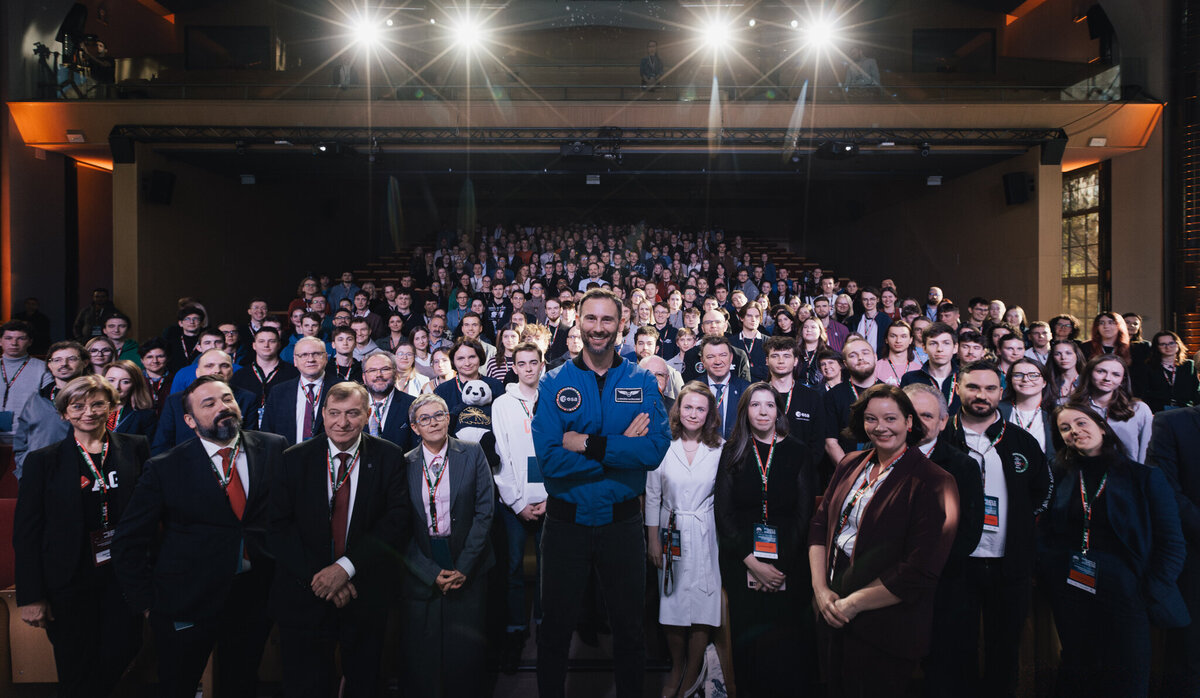
Sławosz Uznański-Wiśniewski visits AGH University. Photograph: AGH University KSAF

HYPE satellite by the SatLab student research club. Photograph: AGH University KSAF

The LUNARIS regolith analyser tested in the European Space Agency. Photograph: AGH Lunar-Technologies

Turbulence, the first Polish student rocket with a liquid engine. Photograph: AGH University

AGH Space Systems wins the prestigious Australian Rover Challenge 2025. Photograph: Kamila Kopacz
 AGH Solar Plane comes fifth in SUAS 2026
  The future of technical universities and quality of education in focus at AGH University
  Academia and industry unite for AI: establishment of CESAR
  AGH University in 2026 Global Ranking of Academic Subjects
  Polish Press Agency launches Scientific Think Tank with AGH University
  Can tree pests yield biopolymers? AGH University researcher seeks sustainable solution

