Skip to content Skip to footer
News

Towards more cost-effective fuel cells

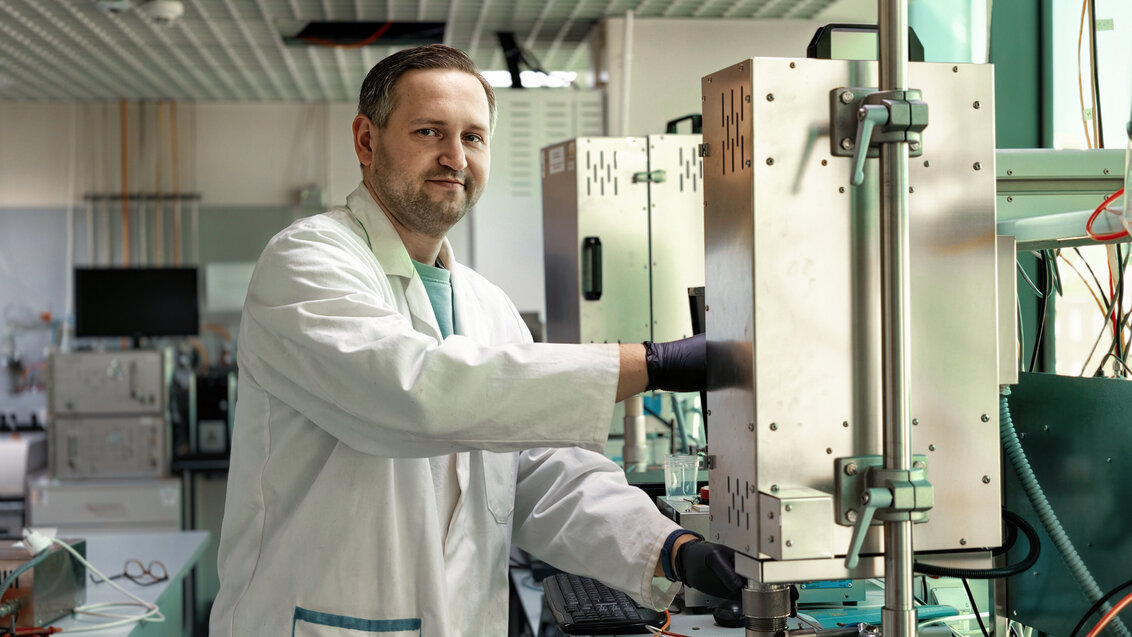
A person wearing a white lab coat is operating a piece of laboratory equipment.

Dr Piotr Winiarz standing next to an integrated electrochemical measurement system. Photograph: Marianna Cielecka

Towards more cost-effective fuel cells

Dr Piotr Winiarz from the Faculty of Energy and Fuels is carrying out an NCN-funded research project investigating materials with a negative thermal expansion coefficient. Preliminary results suggest that their use offers an opportunity to generate green energy with greater efficiency.

Fossil fuels are a convenient source of energy that has dominated the global energy market for decades. However, as energy demand rises and non-renewable resources dwindle, demand for other energy sources, particularly green ones, is also increasing. One such example are solid oxide fuel cells, which do not require the combustion of fossil fuels.

Solid oxide fuel cells

Solid oxide fuel cells are devices that, through simple chemical reactions, generate electricity from hydrogen and oxygen, the latter of which can be obtained from the air. A cell consists of three layers: the anode, the electrolyte and the cathode. Hydrogen is supplied to the anode, and oxygen (or air) is supplied to the cathode. The resulting chemical reactions, such as oxidation and reduction, generate a potential difference that can be used to produce electricity. The only by-product of the process is water vapour, so it is an environmentally and atmospherically friendly solution.

Despite their many advantages, the potential of fuel cells is not yet fully tapped. The largest fuel cell stacks currently in production are capable of generating hundreds of kilowatts, or even megawatts, of power. Unfortunately, in part because they wear out relatively quickly, these cells are currently used primarily as a backup power source.

For fuel cells to become even more cost-effective and suitable for large-scale deployment, including as a primary energy source, their long-term stability must be improved. The operating temperature required for such a cell is around 600°C, so the materials it is made of are heated, causing their properties to change. Importantly, the materials that make up a fuel cell have different coefficients of thermal expansion; consequently, they react to elevated temperatures in different ways and deform unevenly. These processes result in stresses and microcracks, causing the cell to wear out at an ever-increasing rate; after several thousand hours of operation, it may need to be replaced.

Dr Piotr Winiarz preparing cathode materials for use in solid oxide fuel cells. Photograph: Marianna Cielecka
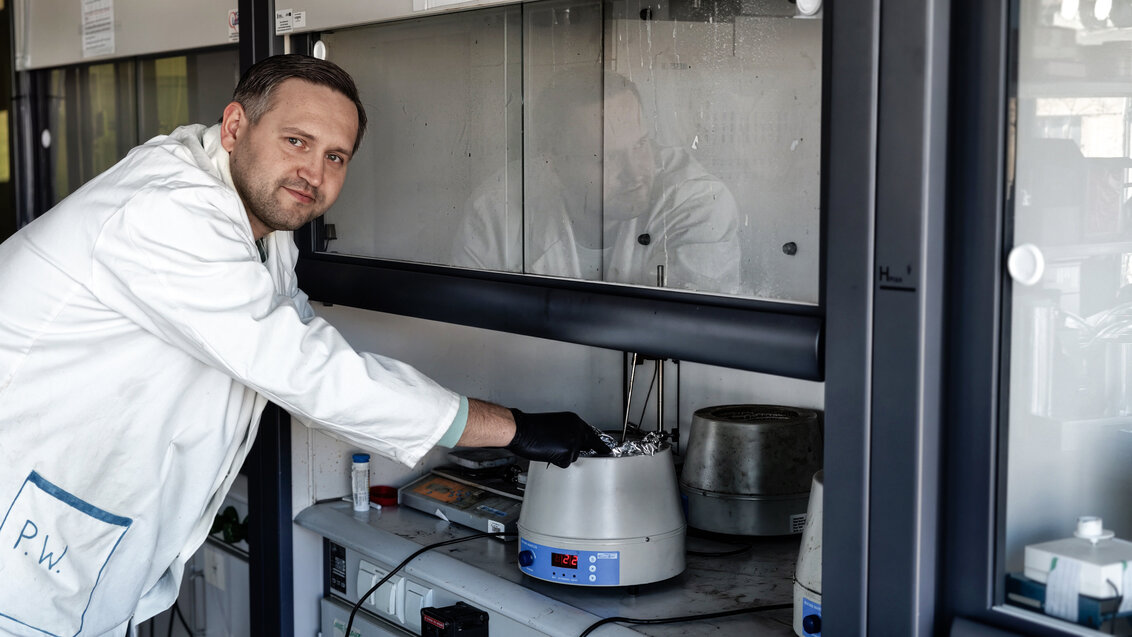
Photo of a man wearing a lab coat working at a heating apparatus under a laboratory fume cupboard

Negative thermal expansion

Dr Piotr Winiarz came to the conclusion that if it were possible to limit the deformation of materials, the cell would wear out more slowly and could therefore operate for a longer period, thereby becoming an even more cost-effective and efficient green alternative. The researcher wants to create composite materials with the required properties, based on the use of materials with a negative thermal expansion coefficient.

Most known materials increase in volume as the temperature increases, meaning that they have a positive coefficient of thermal expansion. This relationship stems from the way atoms behave under specific thermal conditions: when a material is heated, the types of vibration in the crystal lattice change, the bonds weaken, and consequently the average distance between atoms increases. This results in an observable increase in the volume of the material under elevated temperature.

However, some, few materials behave differently – when their temperature rises, they begin to shrink. This is how the perovskite oxide materials discovered a few years ago behave. The underlying causes of this phenomenon are not yet fully understood. According to one hypothesis, negative thermal expansion arises from a characteristic twisting and bending vibration of atoms within the crystal structure. The bond length between atoms remains constant, but it is possible that, for example, in samarium- and manganese-based perovskite materials, which feature metal-oxygen-metal chemical bonds, the metal atoms move closer together. This would lead to a change in the spatial structure within the molecules, the visible result of which would be the contraction of the material. Research carried out by the AGH University scholar may provide new information to either confirm or refute this hypothesis and explain the underlying causes of negative thermal expansion.

To date, inorganic materials with negative thermal expansion have not been sufficiently characterised. Therefore, one of Dr Piotr Winiarz’s research objectives is to identify and thoroughly describe materials that exhibit this behaviour. His project Negative thermal expansion coefficient materials exploration for high-performance composite cathodes preparation in solid oxide fuel cells with increased long-term stability received funding from the National Science Centre (NCN) under the SONATA 21 call for proposals.

Preparation of a sample for thermal expansion testing. Photograph: Marianna Cielecka
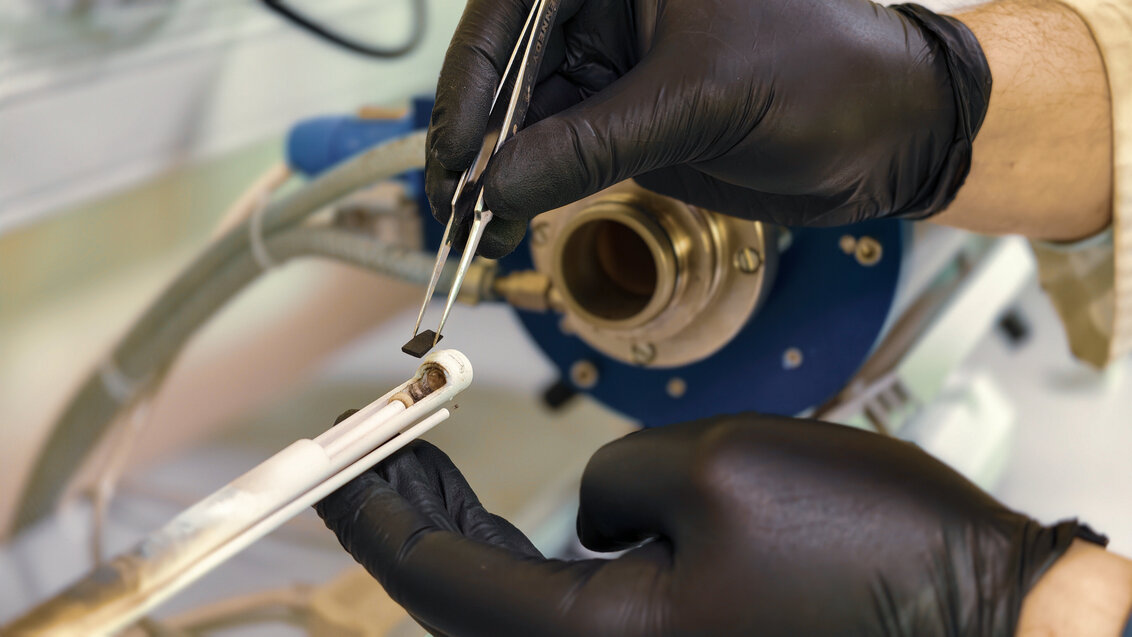
A researcher is fitting a small component using tweezers.

A boost for an eco-friendly energy source

Another objective of the researcher’s project will be to test whether selected materials with negative thermal expansion will improve the long-term stability of the cells. Dr Winiarz proposes adding a material with negative thermal expansion to the cathode, a material with positive thermal expansion, to minimise the effect of high temperatures on the cell’s structure. The structures would not change in volume, thereby preventing the accumulation of stresses and cracks that lead to cell wear. Preliminary results from research carried out by Dr Piotr Winiarz show that this approach is effective in practice and that, owing to such combination of materials, solid oxide fuel cells may indeed wear out more slowly.

For the material to be used in fuel cells, it must be a ceramic cathode material that is stable and has good electrical properties. Hence the interest in perovskite materials which, unlike other known insulating materials with a negative thermal expansion coefficient, can exhibit good conductive properties.

Dr Winiarz has high hopes for samarium- and manganese-based perovskites with added zinc. In addition, he will study the effects of replacing zinc with other metals such as copper, titanium, iron or chromium. To better understand the role of samarium, the researcher will investigate compounds in which it is replaced by other rare-earth elements, including lanthanum, praseodymium and neodymium. By comparing the results, it will be possible to determine the significance of the individual components of the composite material. In total, around 150 different materials will be synthesised and studied as part of the grant.

The composite cathodes obtained will be subjected to both macroscopic observations (to determine whether the material actually shrinks when exposed to heat) and Raman spectroscopy and infrared spectroscopy, which will enable the materials to be examined at the atomic scale. As Dr Winiarz points out, the vibration patterns of each material are like its fingerprint – every material has its own unique pattern. Therefore, one of the aims of the project is to investigate how temperature affects the vibrations of atoms in different materials, i.e. whether the vibrations become weaker, cease altogether, or undergo any other changes. X-ray diffraction may also prove useful in characterising materials, as it allows the crystalline structure of a material to be examined and any structural changes to be identified.

Of the materials included in the research, few have been previously reported in the literature; therefore, a description of the entire group may shed entirely new light not only on perovskite materials but also on the phenomenon of negative thermal expansion itself.

Dr Piotr Winiarz conducting a thermal expansion test using a Linseis dilatometer. Photograph: Marianna Cielecka
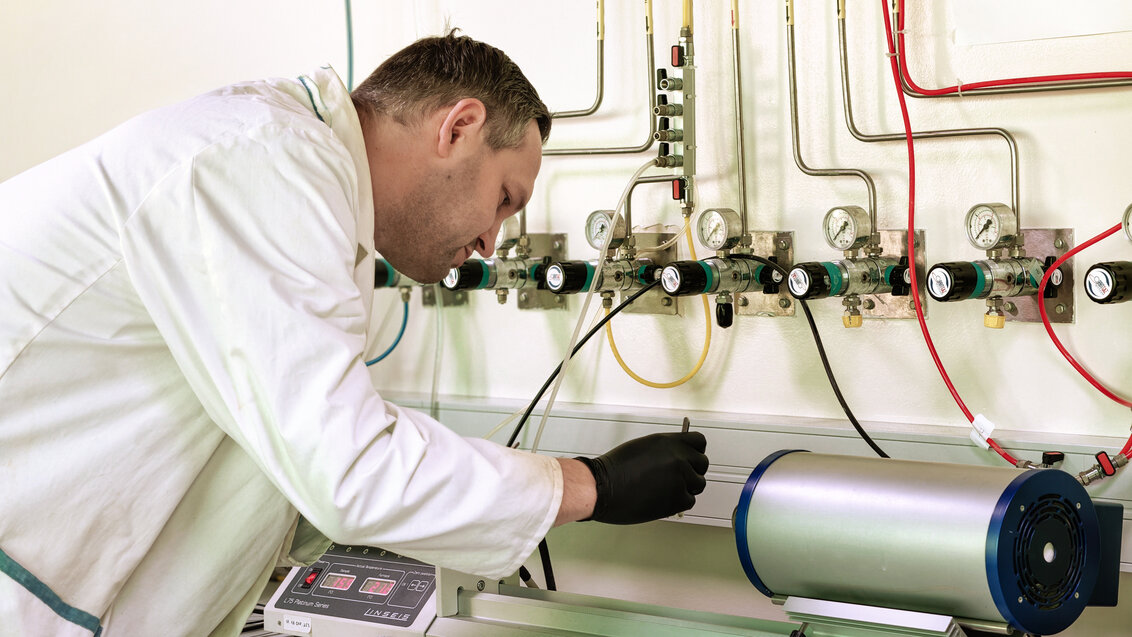
A person wearing a lab coat is taking a measurement at a workstation equipped with pressure gauges and testing equipment.

Stopka