News
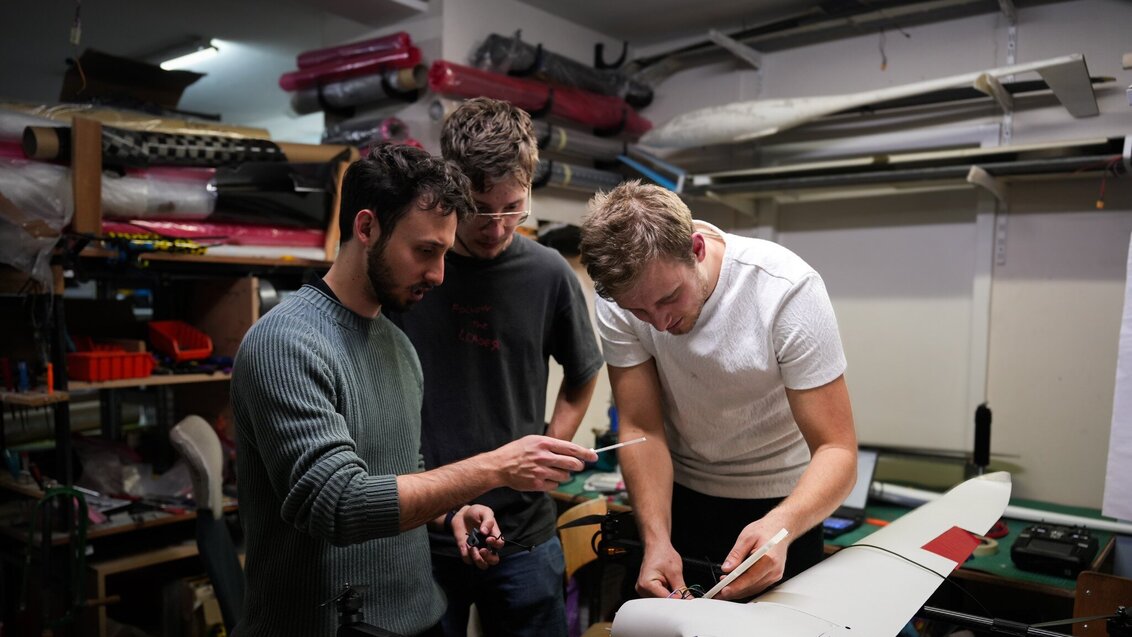
The AGH Solar Plane Student Research Club took first place in the 2026 KoKoS Student Construction Competition in the Sky category for airborne designs. The winning entry was VITOLD, a lightweight and robust unmanned aerial vehicle designed for surveillance and search-and-rescue missions. The device can assist emergency services in performing rapid operations in hard-to-reach or challenging terrain.
“This is a great honour, motivating us to develop even further. We are extremely grateful for the recognition of our design and the hard work and passion that went into creating it,” say the designers.
VITOLD is an unmanned aircraft that combines the advantages of a fixed-wing and a multi-rotor, enabling vertical take-off and landing (VTOL). The lightweight yet durable structure is produced using 3D printing technology from carbon-fibre-reinforced filament with carbon rods and coated with a composite of glass fibre and epoxy resin. The motor positioning mechanism used, resistant to temperature and vibration, enables precise control and smooth changes between flight modes.
In the course of the project, the AGH Solar Plane team used 3D printing technology, which enabled rapid prototyping of key structural components and efficient integration of the body, the drive system, and the electronic systems. He also carried out Computational Fluid Dynamics (CFD) simulations, i.e. computer simulations of the flow of air or other fluids around objects, which enabled the aerodynamics of the structure to be optimised.
The team has developed a telemetry system based on the LTM protocol (which transmits key information from the drone to the operator, such as position, altitude and speed, in real time during flight), as well as a motor rotation mechanism enabling vertical take-off and landing (VTOL). An integral part of the project is also a thermal imaging camera rotation system, which enhances operational capabilities under a variety of conditions.
The system is complemented by video and data transmission systems. The design was field tested under conditions similar to those encountered in real-world missions, confirming its functionality and reliability.
The project received funding from the Ministry of Science and Higher Education and was presented this year at the Drone World Expo in Warsaw.
Other winners of the 2026 KoKoS Student Design Competition
- category: Vehicle
winning design: SKA Robotics and Sirius II
created by: Students' Space Association, Warsaw University of Technology - category: Ecology
winning design: KoNaR_Pripyat with Pripyat
created by: KoNaR, Wrocław University of Science and Technology - category: Life Upgrade
winning design: Active White Cane – a smart mobility assistance system for people with visual impairments
created by: Katarzyna Bodys and Tomasz Kamzol, West Pomeranian University of Technology in Szczecin - category: Smart Robots
winning design: Robal
created by: KoNaR, Wrocław University of Science and Technology - category: Printer
winning design: Insight Robot
created by: Mikołaj Stasiak, Warsaw University of Technology - category: Joker
winning design: End-effector with a sensor system for the Scorpio manipulator
created by: OFF-ROAD, Wrocław University of Science and Technology
The final took place from 9 to 10 May 2026 at AGH University.
 Academia and industry unite for AI: establishment of CESAR
  AGH University in 2026 Global Ranking of Academic Subjects
  Polish Press Agency launches Scientific Think Tank with AGH University
  AGH University and the Polish Dual-Use Chamber join forces to promote the development of national security technologies
  AGH University students at a Summer Camp in Slovenia
  Economic Forum in Karpacz: three days of debates featuring AGH University experts

