News
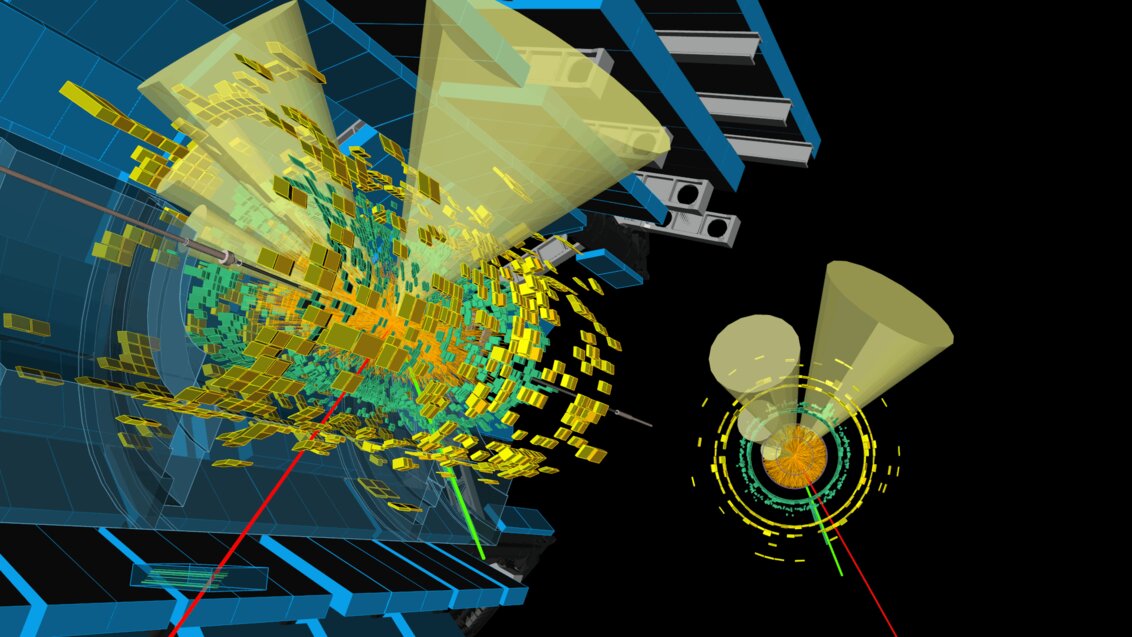
A visualisation of the Pb-Pb collision registered by the ATLAS detector in 2018. The collision produces a candidate top quark pair, which decays into an electron (green line), a muon (red line), and particle jets (yellow cones). A modified image. Source: atlas.web.cern.ch/Atlas/GROUPS/PHYSICS/PAPERS/HION-2022-10/
A team of researchers from AGH University detected the presence of top quarks in an unprecedented way. The observation was reported in the prestigious Physical Review Letters, and as a result, we will be able to learn more about the very first moments of our universe.
The Big Bang supposedly took place around 14 billion years ago. Right after that, for a fraction of a second, what we now call the universe took the form of quark-gluon plasma, extremely hot and dense matter. As per the Standard Model, i.e. the theory at the foundation of modern physics, top quarks were present in the quark-gluon plasma. According to the model, these are the heaviest of the six existing quarks. When the plasma began to cool, the lighter ones combined with gluons to form protons and neutrons. The heaviest disintegrated too quickly and do not occur naturally in nature today.
To observe them, researchers make particles collide in accelerators such as the Large Hadron Collider (LHC) in Switzerland. For this purpose, they accelerate protons or lead nuclei to enormous speeds, close to the speed of light, and special equipment allows them to capture the elements created in the collision and use them to understand the reactions taking place. The chances of producing quark-gluon plasma increase if two nuclei collide centrally. If the collision is peripheral, the chances decrease. As predicted, because of the collision of atomic nuclei, matter should assume a state close to that of the first moments of the universe's existence for a fraction of a second. In the quark-gluon plasma that existed at that time, before it cooled down, the top quarks were able to move freely. Today, outside a laboratory, quark-gluon plasma occurs in the inner core of neutron stars.
It is extremely difficult to observe top quarks, also known as t quarks, because of their high mass, which causes them to decay quickly. Their mean lifetime is 10⁻²⁵ seconds, or one ten quadrillionth of a second. That is less than the time it takes for a photon (a particle of light) to pass through a single hydrogen atom! Therefore, instead of trying to capture the top quarks themselves, physicists study them by measuring the products of their decay.
The first observation confirming the existence of top quarks was made only 30 years ago, which is why this field of research still holds many unknowns, making it an interesting topic for scientists. Professor Grabowska-Bołd from the Faculty of Physics and Applied Computer Science admits that due to their being the heaviest particles of the Standard Model (even heavier than the Higgs boson), they must have some special properties. They are expected to be very sensitive to various effects that physicists have not yet discovered, so their study gives hope for observing something new.
The first observation of t quarks took place in the USA as a result of a proton-antiproton collision. The Large Hadron Collider, used by researchers from AGH University, allowed the collision energy to be increased by an order of magnitude compared to the first observation – up to 13.6 TeV (almost 14,000,000,000,000 eV!). This opened new possibilities for physicists to search for different particles and allowed them to evaluate the predictions of the Standard Model with much greater precision.
Importantly, until now, top quarks could only be observed in proton-antiproton or proton-proton collisions. Although the latter type of collision is the most common one at the LHC, mixed collisions (e.g. proton-lead) and collisions of atomic nuclei alone are also conducted. Professor Grabowska-Bołd and her doctoral student Patrycja Potępa with their team decided to investigate the latter, as they searched for traces of top quarks in collisions between lead ions, known as lead-lead collisions.
The fact that collisions of lead ions are particularly well suited to recreating the conditions prevailing in the early universe was of foremost importance for their making this choice. Lead ions are simply atoms stripped of all their electrons. Due to the high mass of lead ions in collisions, matter with extreme density and temperature is created. However, observing t quarks in lead-lead collisions is more difficult than capturing them in proton-proton collisions.
As explained by Patrycja Potępa, an AGH University doctoral student and the leader of the group responsible for data analysis:
"Lead, as an atomic nucleus, consists of many nucleons, 208 nucleons, protons and neutrons, to be exact. In such collisions, a lot of background noise is generated from the collisions of other protons and neutrons."
The key task of physicists is to filter out this noise from the data and determine whether there is a signal indicating the presence of top quark decay products.
The top quark decays into a W boson and a b quark. But that is not all, because the boson can then decay into two quarks or into a lepton (e.g. a muon or an electron) and a neutrino. In this study, the researchers focused on analysing cases in which pairs of top quarks were produced (this is more likely to happen than the production of a single top quark). These then decayed into two W bosons and two b quarks. One W boson then decays into an electron and an electron neutrino, and the other into a muon and a muon neutrino. Therefore, what should ultimately be produced after the decay of two top quarks are an electron, a muon, two neutrinos, and two b quarks.
If we observe them, can we be sure that they are derivatives of top quarks and not by-products of some other process?
“We cannot be entirely sure, which is why we must consider not only the process we call 'signal', that is, the production of two t quarks, but also all other processes that have the same final state, which we call ‘background’. And now we see the sum in the data, both the signal and the background; everything mixed together. To determine the percentage of the signal and the background, we need to perform a simulation – called a Monte Carlo simulation – and conduct a complex statistical analysis. Only then can we determine the percentage of signal and background,” clarifies the doctoral student.
The results obtained by the team from the AGH University of Krakow allow us to conclude that top quarks were indeed created in the lead-lead collision at the LHC. This is the first observation of its kind in the world; until now, no team had been able to present sufficiently convincing data to conclude with certainty that a top quark had been observed in a lead-lead collision. However, in the case of the measurement obtained by the AGH University researchers, the number of cases observed is high enough (22) and the probability of obtaining such a result by chance is low enough that the evidence was considered sufficient. (The results exceeded the threshold of 5 σ, which is significant in physics, which means that the probability that the observed signal is a background fluctuation is less than 1 in 3.5 million.)
The obtained results are consistent with the Standard Model, the Big Bang theory, and the resulting evolution of the universe. They indicate that top quarks were in fact produced after the collision of heavy nuclei and that their decay products could be observed following the collision.
Demonstrating the possibility of observing t quarks in such a process could expand our knowledge on the origins of the universe. Scientists hope that such an observation will give them the opportunity to better understand the properties of plasma, the mechanisms behind it, and trace its evolution over time, i.e. understand what happened in the plasma after the explosion step by step.
“Before t quarks were even discovered in our study, people were saying that we needed to measure them, as they would provide new opportunities for studying temporal evolution. So, we will try to divide the various stages of what happens to the quark-gluon plasma. ‘Try’ because we produce it in heavy ion collisions and it cools down very quickly, expands, and in fact we no longer have quark-gluon plasma after a very short time. Therefore, we would like to divide the time in which the quark-gluon plasma exists into different stages, and top quarks provide us with this opportunity – we can start looking into these time windows and see what is happening in the quark-gluon plasma,” says Professor Grabowska-Bołd.
Therefore, the report was considered significant enough to be published in Physical Review Letters, considered one of the most important journals in the field of physical sciences, and discussed as a ‘Research Highlight’ in Nature, one of the most prestigious scientific journals in the world. For that to happen, the paper must have gone through a series of in-depth analyses performed by specialists from the ATLAS experiment, and only then was it reviewed by the journal. Researchers who are part of this collaboration are granted permission to publish only if they incorporate all suggested corrections, dispel any doubts about substantive issues, and demonstrate that the research was conducted with the utmost care.
The publication is a result of the first joint measurement recorded with the team of Professor Matthias Schott as part of cooperation with the University of Bonn – Bonn Krakow Laboratory for Heavy Ion Physics. Further research will be carried out under a Preludium grant, financed by the National Science Centre (NCN), obtained by doctoral student Patrycja Potępa to continue the team’s work and lead to a new iteration of results. The results obtained thus far were presented by the student at the renowned conference Large Hadron Collider Physics (LHCP) 2025, where she received an award for her poster.
The physicists claim that the team will not stop there. Although further confirmation of the Standard Model is encouraging and definitely something to boast, many physicists are eagerly awaiting results that contradict the model, which would provide the basis for new physics – physics whose existence we assume due to gaps in the Standard Model, but about which virtually nothing is known.
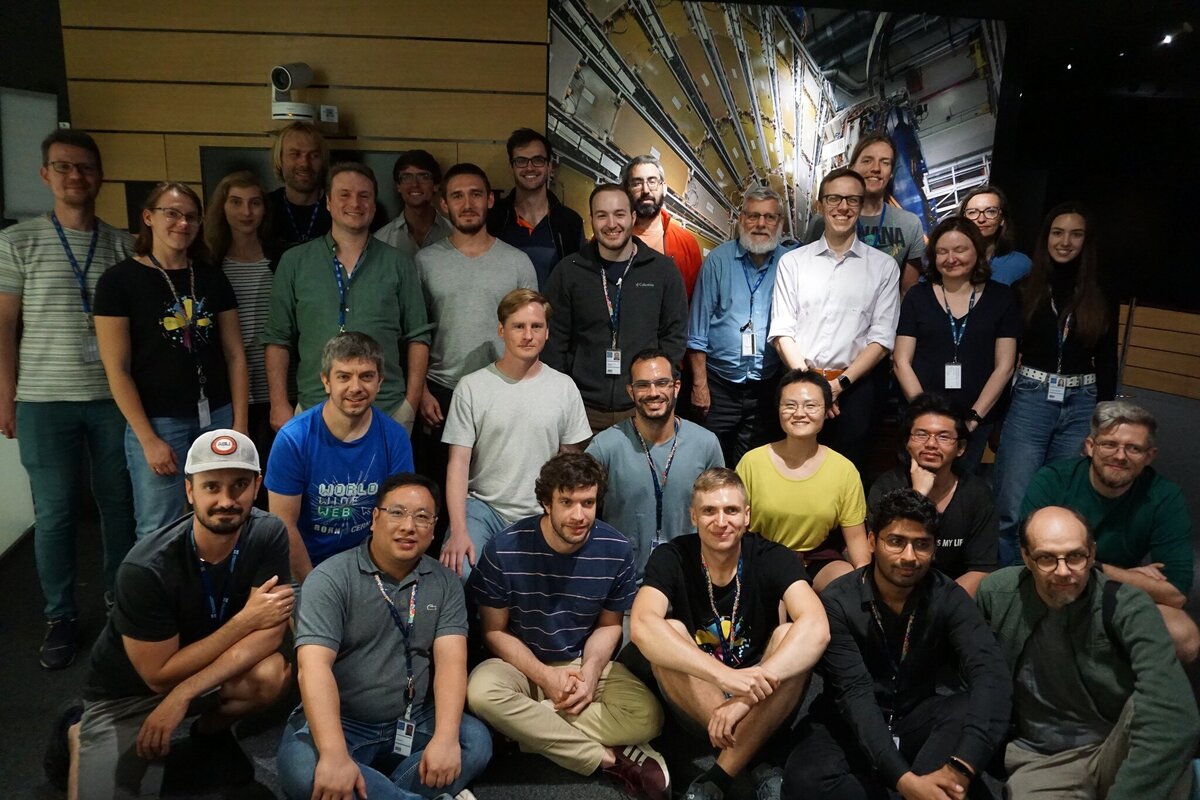
The ATLAS experiment's heavy-ion group collecting data from Pb-Pb collisions at CERN in 2023. Photograph: ATLAS Collaboration, CERN
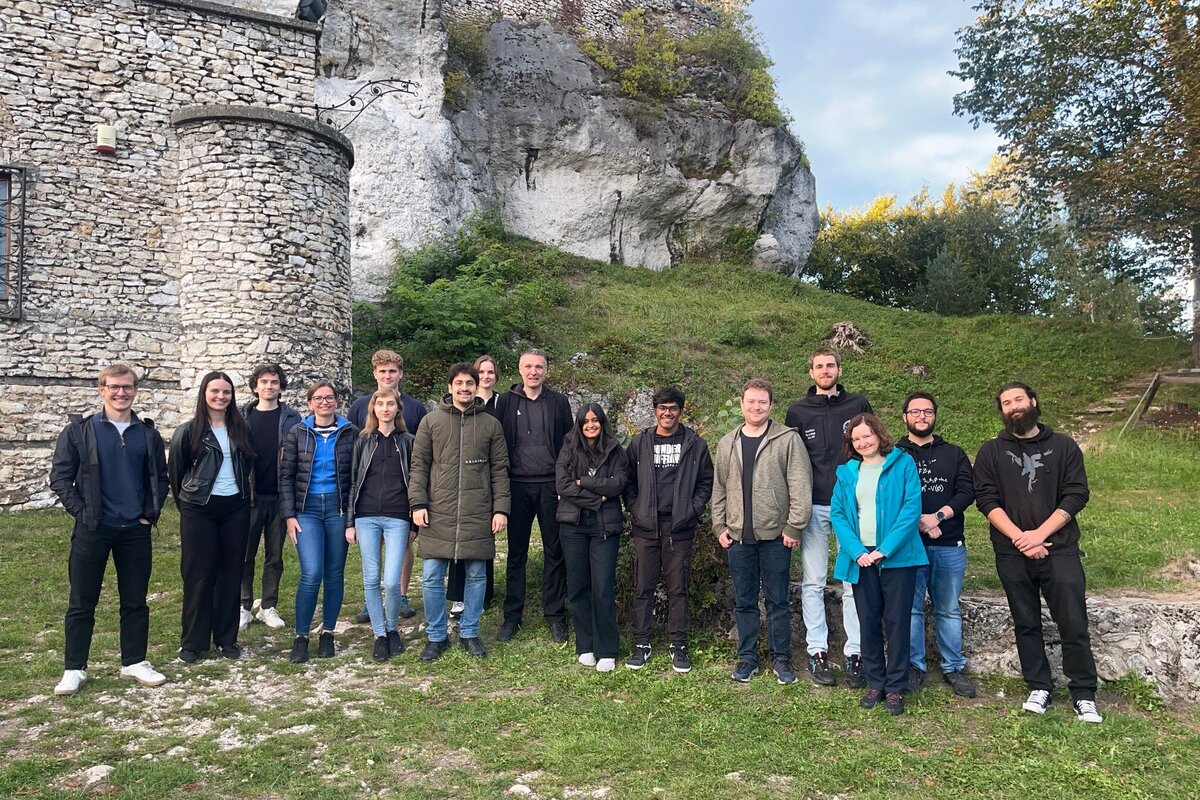
Participants of the Polish German School of Heavy Ion Physics, including Professor Iwona Grabowska-Bołd, Professor Matthias Schott and Patrycja Potępa. The initiative was established as part of cooperation with the University of Bonn – Bonn Krakow Laboratory for Heavy Ion Physics (Morsko, Poland). Photograph: Matthias Schott
 New academic year discounts in AGH University e-Shop
  Monitoring mining and post-mining areas: AGH University part of MINERVA research project
  AGH University Rector appointed Chair of IZTECH Council
  AGH University retains its position in THE World University Rankings 2027
  Two AGH University projects with FIRST TEAM grant
  From nanoparticles to optogenetics: AGH University researcher on a path towards precise neural control
  A university shaping the future
  Web of Science AI Research Assistant – trial access

