News

Photograph: Kamil Marchewka, AGH University Krakow Student Photo Agency (KSAF)
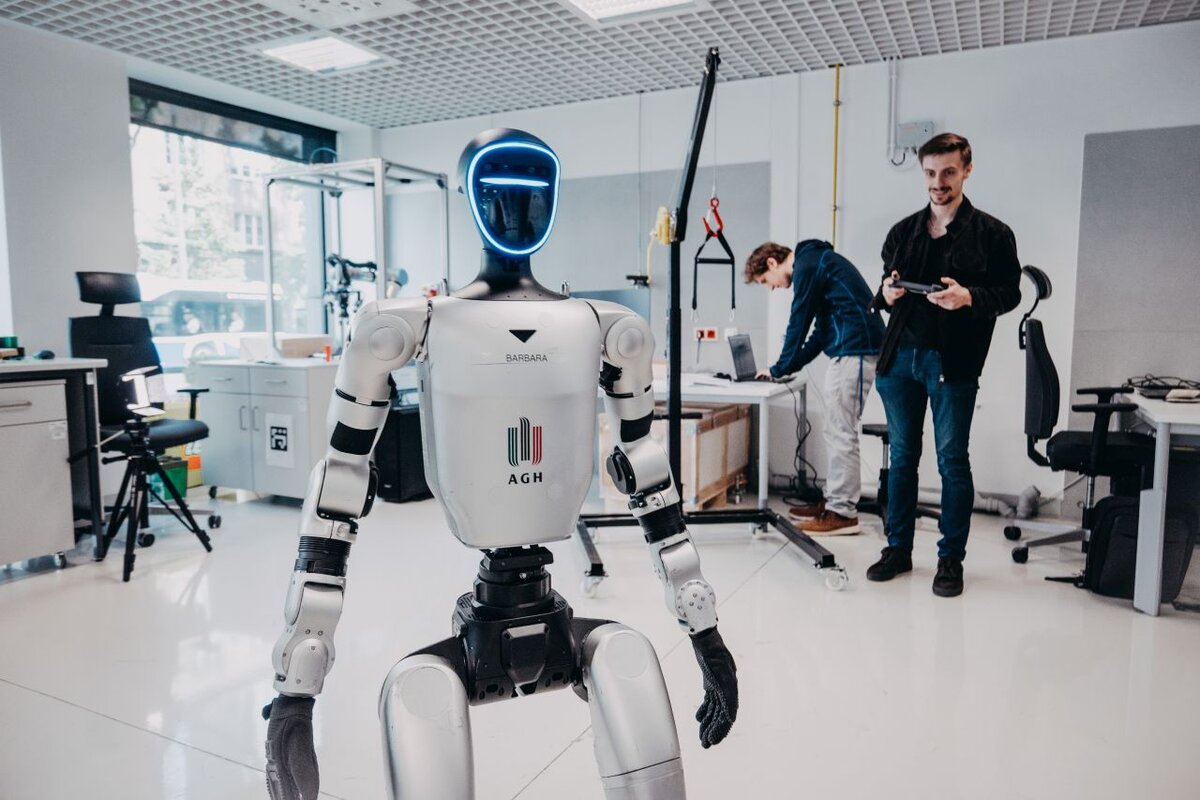
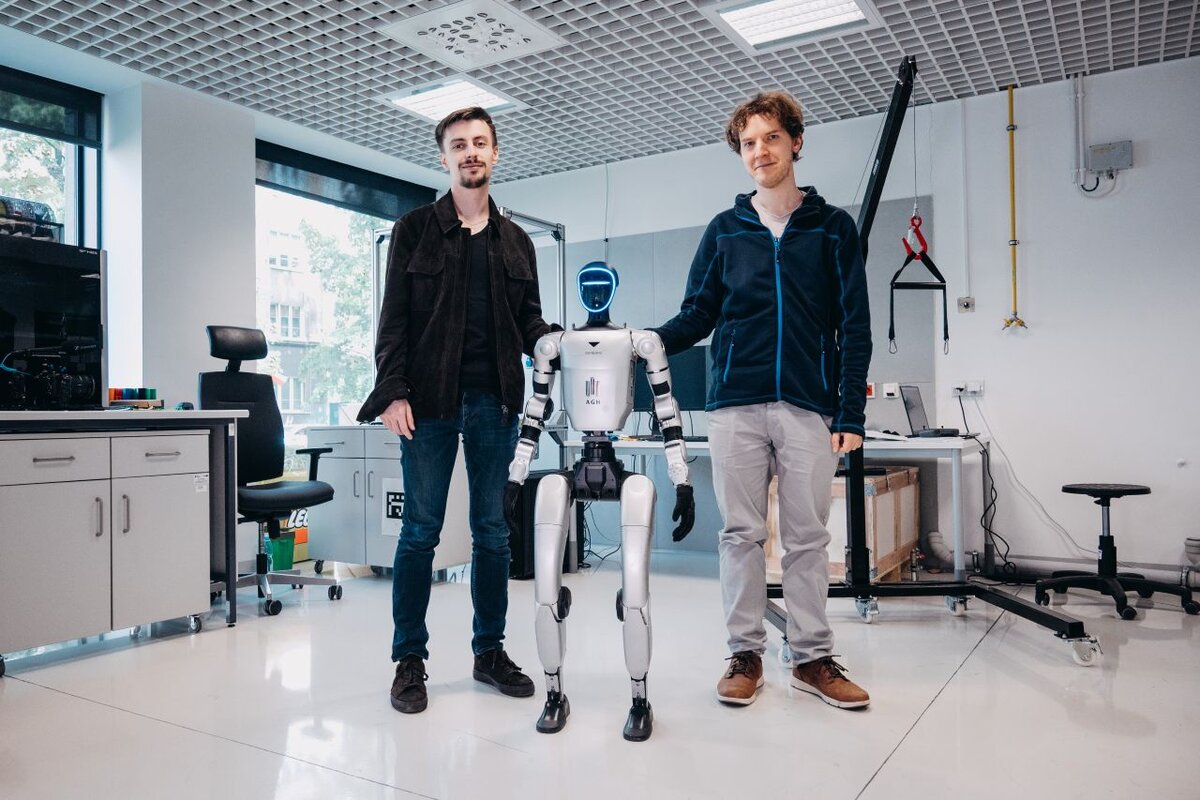
The AGH University Centre of Excellence in Artificial Intelligence has acquired a state-of-the-art humanoid robot, Barbara. The Unitree G1 Edu U2 is a professional educational and research robot designed as a platform for working with artificial intelligence algorithms.
“The robot has excellent motor skills and movement stability. It can move smoothly and perform programmed gestures. However, the key aspect is the openness of the platform, which allows us to make extensive modifications to the software. Our aim is to make the robot more human-like. First, the team introduced a speech module, which they managed to do in just one week. The next logical step will be to equip Barbara with fully functional, precision robotic hands and to implement algorithms for grasping and manipulating objects,” explains Jan Tyc from the Centre of Excellence in Artificial Intelligence.
“Barbara will serve as an important research and teaching tool, allowing the practical testing of AI algorithms in a physical environment. Consequently, we will be able to work on the integration of perception, control, machine learning, and human–machine communication systems. This is a significant step forward in the development of the university’s expertise in modern humanoid robotics and AI applications,” emphasises Professor Joanna Jaworek-Korjakowska, director of the AGH University Centre of Excellence in Artificial Intelligence.
Two development paths: research and promotion
The robot was purchased with two main purposes in mind. The first is strictly academic work. The Centre of Excellence in Artificial Intelligence is home to a team specialising in mobile and humanoid robotics. Its engineers are testing the most advanced reinforcement learning algorithms, meaning that a machine is independently developing optimal ways of moving by interacting with its environment.
The second pillar of the project is the promotion of AGH University’s research achievements. As one of the most advanced designs of its kind, Barbara is set to become a showcase for the university’s innovation at industry and academic events.
A breakthrough in stability and computing power
The design of the Unitree G1 Edu is exceptionally dynamic, as the robot can not only walk but also run. It can automatically regain its balance after stumbling or being given a slight push, which is a huge step forward compared to older generations of robots, which required defined movement paths and often malfunctioned under more challenging conditions. Thanks to novel stabilisation systems, Barbara is able to respond independently on the spot and, should she fall, return to a standing position without the operator’s assistance.
Inside the robot lies a powerful computing system: an 8-core processor and an Nvidia Jetson Orin module. It is what enables researchers to implement their own computationally intensive AI models. The Edu version provides access to the robot’s low-level functions, paving the way for testing scenarios such as sorting products on production lines or providing logistics support within buildings.
The core of the Polish speech system
AGH University is currently developing an innovative proprietary voice communication module.
“The speech system is based on advanced sound recognition, which is then analysed by a language model. At the heart of this system, which allows for natural interaction with Barbara, is Bielik, Poland’s best language model (LLM), developed with the support of Cyfronet. As a result, the robot not only understands commands, but is also able to generate logical and grammatically correct responses,” explains Sebastian Jankowski from the Centre of Excellence in Artificial Intelligence.
Photo gallery
Photograph: Ewa Biśta
Photograph: Ewa Biśta

Photograph: Jakub Maniecki, AGH University Krakow Student Photo Agency (KSAF)

Photograph: Paweł Strzałkowski, AGH University Krakow Student Photo Agency (KSAF)

Photograph: Paweł Strzałkowski, AGH University Krakow Student Photo Agency (KSAF)
 New academic year discounts in AGH University e-Shop
  Monitoring mining and post-mining areas: AGH University part of MINERVA research project
  AGH University Rector appointed Chair of IZTECH Council
  AGH University retains its position in THE World University Rankings 2027
  Two AGH University projects with FIRST TEAM grant
  From nanoparticles to optogenetics: AGH University researcher on a path towards precise neural control
  A university shaping the future
  Web of Science AI Research Assistant – trial access

