News

The growing share of renewable energy sources, such as wind and solar power, presents new challenges to the energy sector. Although they generate energy without producing any emissions, their output is highly dependent on weather conditions and does not always match current demand. That is why energy storage technologies play a key role in the energy transition. Such a solution is currently being developed by Polish and German research teams from the Institute for System Dynamics at the University of Stuttgart, the Silesian University of Technology, and AGH University, which serves as the project coordinator.
Towards a stable energy
The project focuses on the development of innovative compressed air energy storage systems (micro-CAES). In such systems, surplus electricity is used to compress air and store it at high pressure. When energy is required, compressed air is expanded, which drives the electricity-generating equipment.
One of the main issues with this technology is its low exergy efficiency. Current prototypes utilise only about half of the energy used to compress air. The researchers want to understand the processes of gas expansion and heat transfer and learn to optimise them for improved energy recovery.
The research will involve both laboratory experiments and advanced computer simulations. The team will analyse the interaction between compressed air storage and thermal energy storage, as appropriate use of thermal energy can significantly improve the efficiency of the entire system. The originality of the design is demonstrated by the use of pulsed air expansion, which allows better use of the energy stored in the system and reduces losses.
The project results may contribute to the development of a new generation of energy storage systems for RES-based electricity grids. More efficient energy storage means a more stable electricity supply, a reduced dependence on fossil fuels, and lower gas emissions.
If the research proves successful, compressed air energy storage could become an important component of future smart energy systems, supporting the development of a safe and low-carbon energy economy.
More about the project
The project “Multidirectional research and optimization of the dynamics of gas expansion in the complex of the mechanical and thermal energy storage and the expander for micro-CAES” is carried out as part of the OPUS 28 LAP call for bilateral projects. It is funded by the National Science Centre (NCN) and the German Research Foundation (DFG).
The total value of the project is PLN 3,035,738, of which PLN 1,918,979 comes from NCN funding and PLN 1,116,759 from the DFG. The funds allocated for conducting research at AGH University amount to PLN 959,571.
AGH University’s input
The AGH University research team, led by Professor Jacek Leszczyński, comprises researchers from the Faculty of Energy and Fuels and the Faculty of Mechanical Engineering and Robotics. The research will also involve students who are part of LINE Linked Energy, an AGH University student research club.
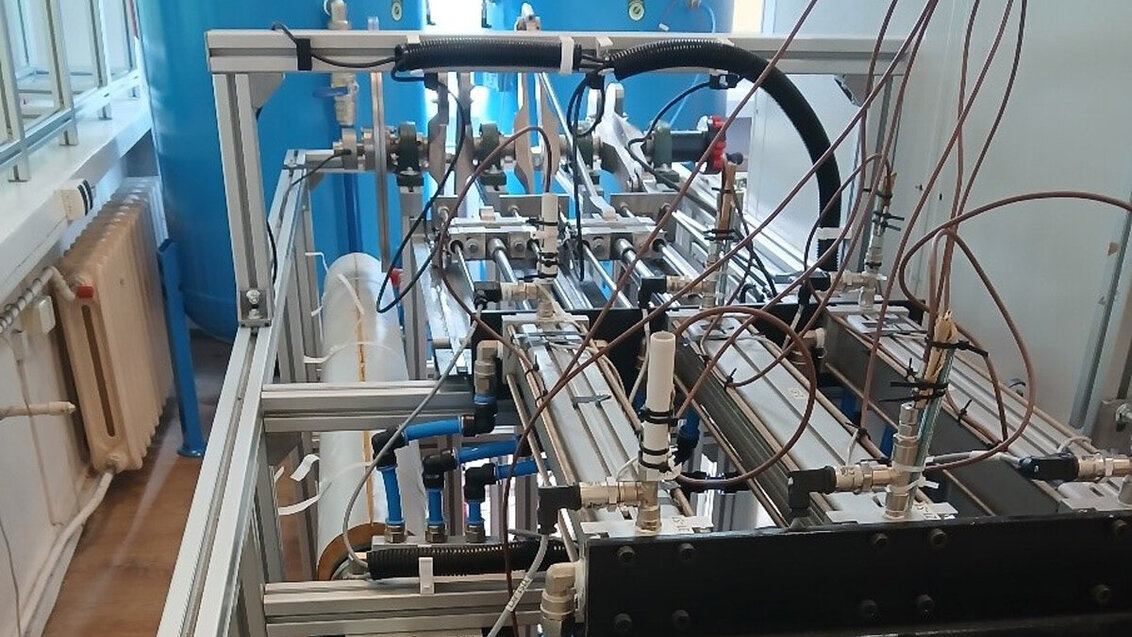
The university’s input will consist in experimental and theoretical research on the expansion of compressed air, using a unique test rig fitted with a multi-piston expander.
In accordance with the principles of open science, the data generated in the course of the project will be made available in the RODBUK Open Research Data Repository.
In line
Multi-piston expander at AGH University. Photograph: Jacek Leszczyński
 AGH Solar Plane comes fifth in SUAS 2026
  The future of technical universities and quality of education in focus at AGH University
  Academia and industry unite for AI: establishment of CESAR
  AGH University in 2026 Global Ranking of Academic Subjects
  Polish Press Agency launches Scientific Think Tank with AGH University
  Can tree pests yield biopolymers? AGH University researcher seeks sustainable solution

