News
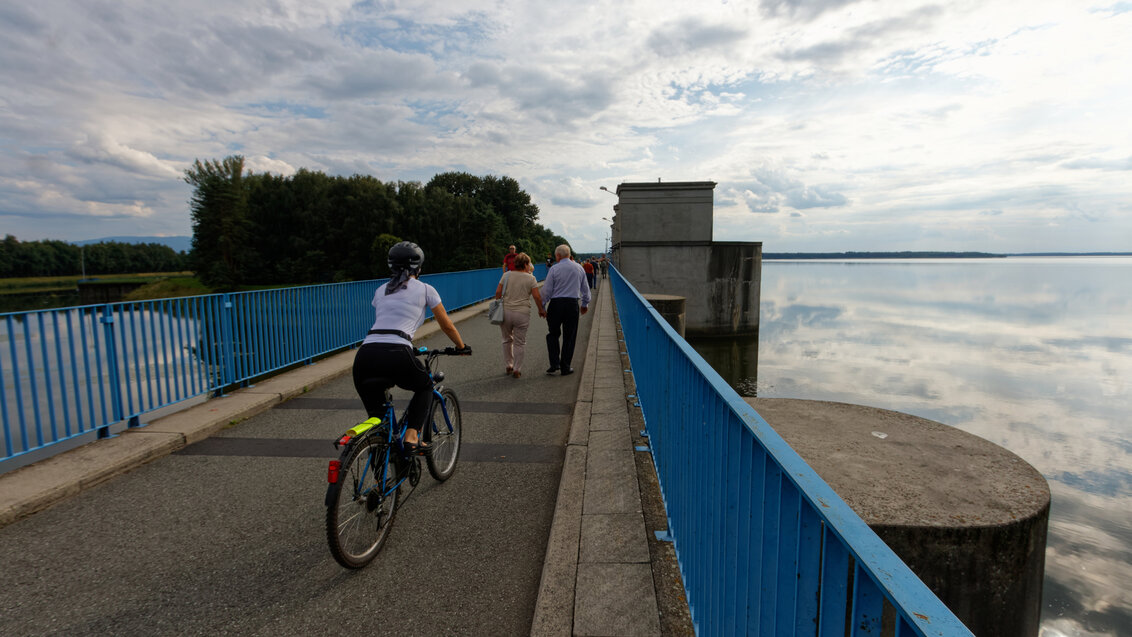
Dam and reservoir in Goczałkowice-Zdrój. Photograph: Dreamstime
Global warming leads to increasingly more frequent extreme weather conditions, such as droughts and torrential rains, which also occur in our part of Europe. A team of researchers from AGH University and the Technical University of Košice is currently working on new methods of environmental impact assessment to better prepare upcoming investments for the challenges ahead. Read our conversation with Dr Slávka Gałaś from the Faculty of Geology, Geophysics, and Environmental Protection, the project's coordinator.
Piotr Włodarczyk (AGH University Centre for Communication and Marketing): How does climate change affect us in Poland and Slovakia and what climate change effects should we be prepared for in the future?
Dr Slávka Gałaś: Over the last few decades, we have observed some changes in temperature and precipitation trends here in Poland. The number of scorching days and tropical nights has increased significantly, and the average annual sum of precipitation has grown. The increase in the latter results mainly from a higher number of days with extreme precipitation with an insignificant increase in the total number of rainy days.
Representative Concentration Pathways (RCP) 4.5 and 8.5 project continuous growth of the average annual temperature – respectively by 1.3°C and 2.6–4.5°C in case of the second variant, which entails a more intense character of the process. Changes in precipitation will be most noticeable in the north-eastern part of the country.
Temperatures will also rise in Slovakia, with an increase of nearly 2.0–3.0°C by 2050. The number of tropical (30–35°C) and super tropical (more than 35°C) days is expected to increase considerably, especially in the warmest regions. Rainfall patterns will become more irregular, and the periods of drought will intertwine with intense rainfall. Due to higher air temperature and humidity, strong and severe thunderstorms can be more frequent.
Effective adaptation and mitigation strategies will be crucial to managing these changes and minimising their negative effects on society’s health, economy, and environment. When designing new investments, one should strive for reaching a balance between social, environmental, and economical needs.
What aspects of adaptation to climate change should we consider when thinking about new investments in this part of Europe?
In this project, our main focus is on undertakings in water management and mining. When planning investments in water management, such as the construction of retention reservoirs, protection and restoration of wetlands, we should prioritise water retention. Its aim is to limit the effects of droughts, secure water resources in times of scarcity, and reduce the risk of flooding. Another important element is to minimise groundwater and surface water pollution by developing a modern infrastructure for wastewater treatment. In urbanised areas, rainwater management is of particular importance in the context of the growing frequency of extreme rainfall and local flooding.
As far as the mining sector is concerned, efforts should be focused mainly on reducing the impact of its activities on the environment, including on the improvement of the energy efficiency in mining processes. It is also important to take into account the impact of extreme weather phenomena on the extraction, i.e. rainfalls, floods, extreme temperatures, which pose serious threat to the equipment and infrastructure.
How will the project improve the resilience of investments to the whims of weather that are to come?
We would like to deliver new guidelines for public administration, business, and experts responsible for preparing project documentation and participating in Environmental Impact Assessment (EIA) and Strategic Environmental Assessment (SEA) processes. The legally required procedures are best suited for the implementation of tools to solve problems related to the climate resilience of new investments. The assessment methods we are developing will aim to provide a complex answer to the question whether a given project or investment may be significantly affected by the detrimental effects of climate change. For it to happen, we need to identify climate risks, evaluate climate change scenarios for a given area, and assess the project's susceptibility to anticipated future changes. A relevant aspect in the evaluation of investments and projects should also be seeking possible alternatives and solutions to improve their climate resilience. It is also important to ask questions about the way to monitor the unfavourable effects of climate change on investments and projects and the effectiveness of evaluation of the adaptation measures.
Dr Slávka Gałaś
Why are the current environmental impact assessment criteria lacking in this regard?
We are currently dealing with a high degree of uncertainty regarding the impact of climate change on new projects, as we only have observations from a relatively short period of time and we still lack relevant experience in the operation of specific types of investments under new conditions. The preliminary results of our analyses have shown that strategic assessments of the environmental impact carried out in Poland approach this problem in a much more multifaceted way than in Slovakia. However, in both countries, there are areas with insufficient or no implementation in this regard.
How is the project planned to reach its desired result?
Our research is focused on comparing data, models, and methodologies related to climate risk management in EIA and SEA processes in European countries, especially in Poland and Slovakia. Such comparisons will allow for better understanding of the differences and similarities in approaches to assessing the susceptibility of investments and projects to climate change in various regional and national contexts.
Currently, the method of environmental impact assessment in the EIA and SEA processes is being developed. We would like to indicate differences between countries in this regard, and at the same time point to common points of reference. The last stage of our work will be to test the method and present the results of our work to improve and adapt them to local conditions and needs.
What actions will be taken for the tools to take into account local specificity?
We cooperate with local communities, public administration, and socioeconomic partners in both countries to collect and exchange information and experiences. As part of the cooperation, we are also going to analyse data related to investments and projects, EIA and SEA procedures, and test developed methods on specific cases. We hope that it will allow us to accelerate the implementation of the developed solutions and increase their actual application.
How many people are involved in the project and who are they?
The AGH University-based team consists of four persons from the Faculty of Geology, Geophysics, and Environmental Protection, two academic employees and two students who actively participate in the on-going work. At the Technical University of Košice, the group involves five researchers from the Faculty of Mining, Ecology, Process Control and Geotechnology and the Faculty of Civil Engineering. The team represents fields related to environmental engineering, mining and energy as well as earth and related environmental sciences.
When can we expect the final result of your work?
The project is to be completed by the end of 2025.
Thank you for your time.
The project “Enhancing Climate Resilience in Investments and Projects: Innovative Tools and Guidelines for Effective Risk Management” is carried out as part of a programme of the Polish National Agency for Academic Exchange (NAWA) that supports the mobility of scientists conducting joint research projects between the Republic of Poland and the Republic of Slovakia.
 New academic year discounts in AGH University e-Shop
  Monitoring mining and post-mining areas: AGH University part of MINERVA research project
  AGH University Rector appointed Chair of IZTECH Council
  AGH University retains its position in THE World University Rankings 2027
  Two AGH University projects with FIRST TEAM grant
  From nanoparticles to optogenetics: AGH University researcher on a path towards precise neural control
  A university shaping the future
  Web of Science AI Research Assistant – trial access

