News

Although they meet their key function of providing protection, it does not exhaust their potential. According to AGH University researchers, roofs are the perfect place to take advantage of the aggregates they have developed and restore greenery in city centres.
Fighting climate change does not only mean taking actions aimed at prevention, it is also seeking solutions which will allow us to cope with the effects of said changes which cannot be stopped. One of such solutions are green roofs, i.e. filling free spaces on buildings with plants. This solution brings along a plethora of advantages. Above all, it may retain water during heavy rainfall and helps to reduce the occurrence of 'urban heat islands', as the area covered does not heat up as much as concrete or asphalt. Moreover, it also allows to increase the area of green spaces, which has positive impact on the wellbeing of people living close by.
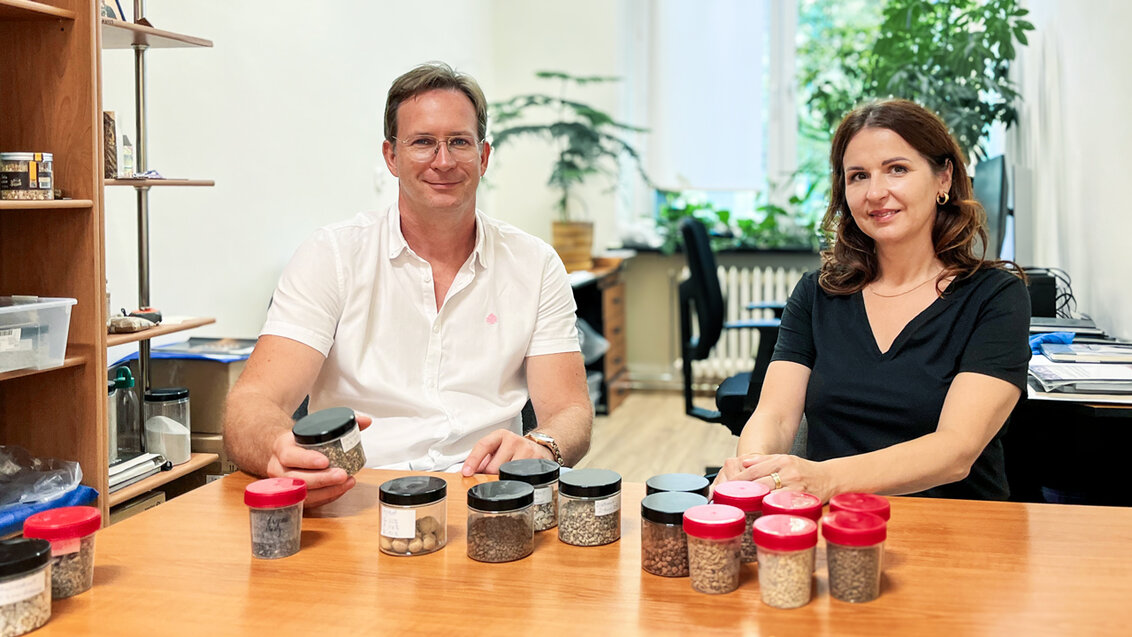
The basis for the establishment of such places are innovative solutions which optimally adapt the infrastructure for its intended functions. Academics from the Department of Environmental Engineering at the Faculty of Civil Engineering and Resource Management, Dr Agata Stempkowska and Dr Tomasz Gawenda, associate professor, have been working on various aggregates, some of which should do perfectly well as a substrate for plants on green roofs.
Hidden value of waste
Plants on green roofs cannot grow in soil, as it is too heavy, particularly after absorbing water, it becomes dusty and can clog drainpipes. According to regulations, organic parts shall not constitute more than 10% of the mass of the garden located on the surface of a building. If is vital for the substrate to absorb large amounts of rainfall water, to provide all substances essential for the plants to live, and at the same time to be made from a light material, one that would not be too heavy by itself.
“We cannot allow for the plants to grow too fast,” explains Dr Agata Stempkowska. “They should be green and not overgrown, as it would also put some additional weight on the construction. Plants are fertilised every once in a while, or a granular fertiliser is used, and that is how they are nourished. We are trying to make aggregates with the addition of various raw materials which already contain all of the most important elements like potassium, magnesium, phosphorus, and others.”
This year, the study by the AGH University scholars focusing on the development of the so-called artificial lightweight aggregate got published in Scientific Reports. Not only does such aggregate have the properties necessary to become a valuable substrate for plants, but also the very process of its development has additional ecological benefits, as it is based on the use troublesome waste raw materials.
“Pioneering in the context of the present project was completely different research we have conducted with the Cracow University of Technology. It consisted in the crushing of concrete slabs, like prefabricated units from the times of the Polish People’s Republic, interestingly enough we got them from the former German Democratic Republic. The aggregate we made was also very good, but it also resulted in the making of large quantities of dust. So we had to ask ourselves: what to do about it? Bearing in mind the importance of circular economy, we should not produce any waste. We came to a conclusion that we should try to combine it with clay,” Dr Agata Stempkowska told us.
Construction waste accounts for around 32% of the world's total waste mass, with rubble making up a significant proportion. Its processing would therefore be of great environmental benefit. Adding it to the aggregates developed by the AGH University researchers is supposed to reduce the plasticity of the mass. It also contains bonding properties owing to which it may be regenerated in the process of burning.
The subsequent ingredients were the clays accompanying basic raw materials, constituting the post-production material. Their purpose is to plasticise and cement the resulting mass.
The third ingredient was waste from the post-processing of PET bottles. Such a material is no longer good enough for reusing in the making of water bottles, as it contains PET, a lot of phosphates, but also contaminants like adhesives and product labels.
Drying to wet
To granulate the materials, a dynamic and a drum granulators were used. During the drum granulation, the materials are placed in a longitudinal counter-rotating drum, inclined at an angle of a few degrees. Inside, the dust rises and rolls off, and a water mist is let in during the process. The particles of dust begin to connect with water, make layers and form granules of various sizes.
“This is a very simple method, however it lacks efficiency. The dust turns into larger particles until we obtain balls and then they are divided in the screener into fractions of various sizes. Later on, they are dried and sintered in different temperatures. That is how aggregates are formed,” explained Professor Tomasz Gawenda.
The dynamic granulation method is faster and creates more granules, but they usually are smaller. It is carried out in a drum and mixer granulator. The drum rotates in one direction and the mixer in the other - both are regulated. By reducing and increasing the speed, accelerating, decelerating, and adding water, lumps are formed very quickly - in a dozen or more seconds. Aggregates from both granulators also have different structures - in the drum method, the granules consist of layers on layers, one on the other. As a result, their porosity decreases. In dynamic granulation method, the obtained balls may not be fully shaped and as compact, but they are more porous. A disadvantage of the latter method are lower abrasiveness parameters which may cause difficulties, for example during transport.
“The temperature during sintering makes the concrete dust, one that we put inside as waste, regenerate itself. Then, the aggregates are cared after in water. At first, the research was not as encouraging, as it turned out that the pH level was too high. And such aggregates could not have been used, for any gardening or agricultural purposes. Later on, I have noticed that, firstly, the pH changes, and secondly, the aggregates have a minimally different mass,” revealed the researcher. “And this allowed me to conclude that secondary crystallisation has taken place. Of course, the aggregates were later tested under the microscope and with the use of other techniques like XRD (X-ray diffraction), which confirmed that we may harden our aggregates in sort of two directions.”
The effect of these observations was the use of the hybrid method for the production of aggregates, so besides sintering we also applied secondary hydration on the clinker phases contained in the aggregate, which made it harder. Hydration does not prevent porosity, so water will be still able to penetrate the aggregates, and plants will be able to source it.
It does not have to take that much
Porosity is one of the most important properties of aggregates intended for plant substrates, however, the perfect recipe is not about producing a material of the highest porosity. It is more complicated than that, because e.g. closed porosity can be distinguished. Lightweight expanded clay aggregate (LECA), used in roof gardens, is one of the aggregates the porosity of which is closed. Although expanded clay has high porosity, it becomes practically useless when used as plant substrate, as the pores are inside the lumps and are not available from the outside. Therefore, water is not able to get and accumulate there, so the roots of plants are not able to take up the water.
They would not be able to use it also in the case of open but small porosity. The optimal porosity for the plants is mesoporosity. The flat aggregates obtained by the researchers with another method developed are characterised by open porosity on a mesoscale, thus they will be able to store water and plants will be able to access it.
With such aggregates, roofs can achieve a high water retention capacity. It is particularly relevant in the face of climate change, which is affecting the nature of precipitation, also in Poland. Rainfalls become less frequent but more heavy. Neither the concrete cities, nor the dried out soil resulting from long periods of no rainfall are able to absorb the water fast enough. It causes floods but the paradox is that it also results in droughts, as the water does not stop in the local ecosystem, but continues to flow further.
The shape of the aggregates is also of significance in terms of the functions performed by them - whether they are round or flat impacts their permeability, i.e. how much air or water will fit into the same volume of the substrate consisting of grains. Developed at AGH University, the grains may also be fully flat, as they bring the most benefits then. Their sample may fit even 30% more air than the same volume sample of globular grains. As a result, the regular-shaped aggregates are far more beneficial in the production of concrete and asphalts, as they collect less water, which during multiple transitions from the liquid to the solid state leads to fractures in the material. In addition, irregular-shaped aggregates, which are flat or elongated due to their larger surface, increases the need for bitumen or cement with water necessary to surround the aggregates. For the same reason, flat aggregates are likely to perform well as substrates for plants. Large spaces between the aggregates will ensure that the roots of the plants are well aerated and therefore provide them with sufficient air.
“Water will soak into the structure of the grain, and if its porous it will get there, but it will also adhere to each particle due to adhesive forces. That water will fill out those spaces and will be kept there for longer. The longer the time, the more beneficial it is for the soaking process. Surely, it will still flow down and it must, as the roots cannot be constantly in water, however the moisture will be there for longer, which is vital for the plants. After all, the idea is for the irrigation to be reduced in the periods between natural rainfall. With round grains, the substrate dries out quicker, we have already studied it. So the shape of the grains and their optimal composition are of particular importance when creating substrates,” explained the researcher.
Also beneficial in combating the effects of climate change is the fact that green roofs are planted with lots of greenery, which heats up much less than concrete. Areas dominated by concrete contribute to the phenomenon of the so-called urban heat islands, because they heat up quickly and give off that heat slowly. Green roofs allow to take full advantage of the land, essential in highly urbanised areas where the demand for residential, commercial, and office buildings is higher than ever, while allowing for maintaining the greenery that heats up much less. Substrates can also help to counteract this aspect. One of the challenges facing the scientists was to develop aggregates that would reflect as much light as possible, so that they would heat up much less than other similar solutions.
The scholars emphasise that the waste used is in no way hazardous. All components and raw materials are comprehensively tested before the aggregates are made, to ensure that they will not be harmful to either the environment or people. Aggregates must not contain heavy elements or any other harmful substances.
Affordable and efficient
In Poland, there are no regulations that would enforce the introduction of green roofs on a large scale. However, it is possible that the European Union will introduce them in the future. In Germany, 30% of buildings must have green roofs, and the materials used for their creation are currently costly. Most often than not these are akadama, vermiculite, expanded clay, and perlite which are made from hardly accessible and expensive natural resources. Using waste for the production of aggregates gives us a chance to obtain the right material at a significantly lower price. The AGH University scholars presume that the price of their aggregate could oscillate around PLN 1000 for 1 tonne, so it would be even 10-times cheaper than akadama, a substrate used for example for cacti and bonsai.
Dr Agata Stempkowska and Professor Tomasz Gawenda are also working on special mineral cores aimed to support plant growth. Such a solution might be particularly helpful in urban areas, where plants do not have optimal conditions for growth. We refer you to the article on its development: mineral composition to support plant growth.

Lightweight aggregate

White aggregate

Mesoporous lightweight aggregate
 AGH Solar Plane comes fifth in SUAS 2026
  The future of technical universities and quality of education in focus at AGH University
  Academia and industry unite for AI: establishment of CESAR
  AGH University in 2026 Global Ranking of Academic Subjects
  Polish Press Agency launches Scientific Think Tank with AGH University
  Can tree pests yield biopolymers? AGH University researcher seeks sustainable solution

