News
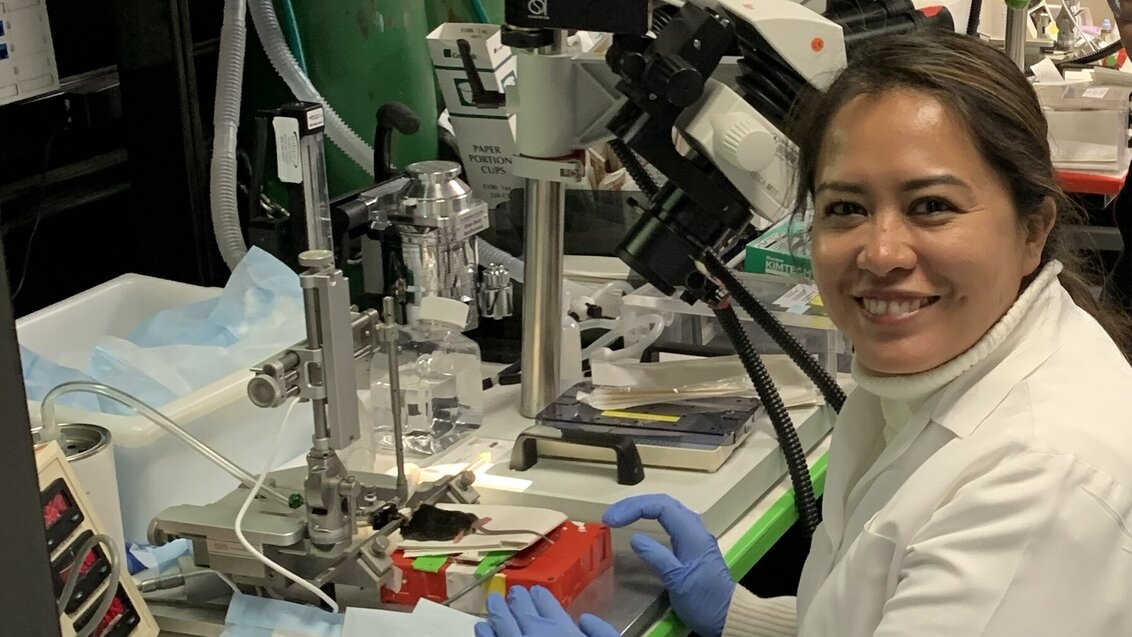
Surgical technical session: injection and implantation in Professor Karl Deisseroth’s lab. Photograph: private archive of Gloria Lesly Jimenez Miranda
Dr Gloria Lesly Jimenez Miranda from the Faculty of Materials Science and Ceramics at AGH University is working on innovative nanoparticles that could advance optogenetics, one of the most promising fields in modern neuroscience, recognised with the 2026 Nobel Prize in Physiology or Medicine. Optogenetics uses light-sensitive proteins to modulate the activity of specific cells, including nerve cells. The purpose of Dr Jimenez’s research is to develop nanoparticles that can deliver light to these proteins, opening new possibilities for precise control of neural activity.
Over the past four years, Dr Jimenez has been conducting research focused on the development and optimisation of nanoparticles, systematically investigating their composition, morphology, surface properties, and optical response, with the long-term goal of creating efficient light nanotransducers that can activate opsins. Working on luminescent materials, she proposed the use of lanthanide-based nanoparticles as light nanotransducers to mediate optogenetics, marking the first step towards integrating advanced nanomaterials science with neural modulation technologies.
In February 2025, Dr G. L. Jimenez participated in an optogenetics workshop offered by the Stanford Bio-X Optogenetics Innovation Lab under the guidance of Professor Karl Deisseroth, recipient of the 2026 Nobel Prize in Physiology and Medicine for his discoveries related to light-gated ion channels and for pioneering the development of optogenetics. During hands-on training, she gained unique experience in key optogenetic techniques, including surgical procedures for opsin delivery and optical-fibre implantation, as well as behavioural experiments.
During her visit to Stanford University, the researcher presented the achievements of the AGH University photonics group led by Professor Dominik Dorosz to Professor Deisseroth and discussed potential future research directions. Professor Deisseroth’s recommendations on specific opsins developed within his research programme have been incorporated into the design of the planned experiments at AGH University.
Dr Jimenez’s research has recently been awarded funding under the National Science Centre (NCN) SONATINA 21 call for the project “Glass@Nanocrystal Hybrid Core–Shell Platform for Simultaneous Imaging and Thermometry” (2026–2029). The project focuses on the development of lanthanide-based nanoparticles using a microwave-assisted technique, providing improved control over and reproducibility of the synthesis process. The resulting platform will provide an important foundation for the future development of reproducible light nanotransducers for optogenetic applications. AGH University serves as the consortium leader for the project, which is carried out in cooperation with the Białystok University of Technology.
The long-term goal of Dr Jimenez is to establish an interdisciplinary research line that combines photonic nanomaterials and optogenetics to enable precise, remote, and minimally invasive neural modulation. Potential applications of this technology include novel methods for the diagnosis and treatment of neurological disorders.
 New academic year discounts in AGH University e-Shop
  Monitoring mining and post-mining areas: AGH University part of MINERVA research project
  AGH University Rector appointed Chair of IZTECH Council
  AGH University retains its position in THE World University Rankings 2027
  Two AGH University projects with FIRST TEAM grant
  From nanoparticles to optogenetics: AGH University researcher on a path towards precise neural control
  A university shaping the future
  Web of Science AI Research Assistant – trial access

