Skip to content Skip to footer
News

Defying gravity with lunar regolith

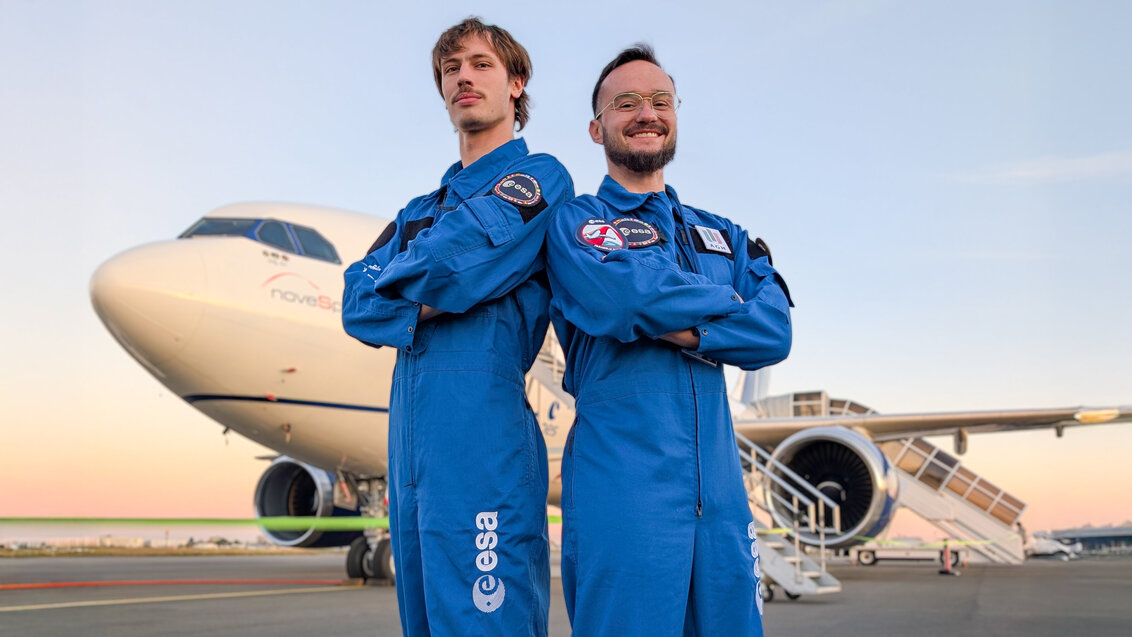
Two people in blue ESA suits standing in front of a large aircraft on the airport tarmac.

Jakub Kopeć and Adam Kolusz, operators of the experiment

Defying gravity with lunar regolith

Researchers at AGH University have conducted experiments under conditions that simulate reduced gravity. Their results may facilitate the colonisation of the Moon.

Earth has certain limitations, for example, in terms of gravity. Overcoming them is not an easy task, but if an aircraft takes the right trajectory and achieves the right acceleration, the effects of gravitational pull may temporarily disappear. Although it only lasts half a minute, scientists are eager to use this method, as it is in fact the only way to simulate reduced gravity without going beyond the Earth's atmosphere.

The so-called parabolic flights are organised by the European Space Agency (ESA) on a regular basis. Scientists may apply to the agency for grants for flights to carry out research. The AGH University team, acting as part of a consortium with the Space Research Centre and the University of Warmia and Mazury in Olsztyn, and the company Spacive, submitted such a grant application for a flight called PETER-PFC, to run experiments as part of their research. The aim of both experiments was to study regolith, i.e. a layer of rock material closest to the surface, under conditions close to that of the Moon. As a result, during the 88th campaign of parabolic flights, our team conducted two experiments developed at AGH University under reduced gravity conditions. The team was made up of Adam Kolusz (doctoral student, principal investigator), Dr Alberto Gallina, associate professor (supervisor), Jakub Kopeć, Kamil Piecha and Dr Wojciech Teper. This is AGH University’s debut in a parabolic flight campaign organised by the ESA. The PETER-PFC project was led by Dr Karol Seweryn from the Space Research Centre of the Polish Academy of Sciences (CBK-PAN). In the course of the project, a Rotary Clamshell Excavator (RCE) developed by CBK-PAN was also tested.

Two high-flying experiments

The first experiment conducted during parabolic flights is the rotating drum test. It consisted in observing the regolith simulants in a specially designed drum. Regolith simulants are materials created to replicate the actual lunar regolith, to be its true copy, so they have the same properties and react to determined environmental conditions in the exact same way.

Simulants are created based on real regolith collected and transported to Earth from the surface of the Moon during the Apollo missions. The total weight of the regolith samples that are currently on Earth is approximately 400 kg, the majority of which are owned by NASA, and a small part comes from Chinese lunar missions. Obtaining a small sample for research purposes is possible, but in research that requires a greater amount of material, researchers opt for simulants. One of them (AGK2010) was developed by AGH University in cooperation with the Space Research Centre. On each day of the experiment, a different simulant was tested under reduced gravity conditions.

The designed drum has been equipped with high-resolution cameras to observe what happens on the inside and later analyse the image in detail. As a result, the researchers will follow and analyse characteristic planes, among others, depending on different rotational speeds. Adam Kolusz is also the mind behind the software that allowed the monitoring of the movements of singular grains of sand.

The second experiment conducted during the flights was the blade cutting test of regolith. In simple terms, placed in a glass box, the regolith was cut and observed to see how it shapes mounds. Internal failure planes were also analysed, i.e. how the soil was arranged deep inside, as such data can help us better calibrate models. The cutting took place automatically following the activation of a mechanism equipped with a special blade and the entire process was monitored using high-resolution cameras.

An additional asset in the second experiment was the opportunity to test MXenes, i.e. modern sensors that were to measure the pressure on the regolith with high precision. The same sensors had been used in the band designed by AGH University researchers that was tested in orbit by Sławosz Uznański-Wiśniewski during the IGNIS mission. The researchers compared that sensor with another commercial sensor (changing resistance under pressure) to see whether the MXene one proves effective in detecting such small forces as those involved in regolith cutting. That part was the main responsibility of Jakub Kopeć from the Faculty of Space Technologies.

“The main idea behind the experiments was to streamline the machine modelling and building process,” says Prof. Alberto Gallina, the project’s supervisor.

Each grain counts

If we want to send, for example, a rover to the Moon, testing it under terrestrial conditions may not suffice. Even if we test it using regolith with the right properties, weaker gravity outside Earth may cause the device to function differently away from our atmosphere. A rover that efficiently digs into the regolith on Earth may have difficulty doing so under lunar conditions, where changes in gravity and other external factors make the process differ. Accurate prediction of the mechanical behaviour of the regolith may enable the discovery of better, more effective tools.

When designing tools for use in extraterrestrial conditions, numerical models would be useful to test the effects of gravity without having to send equipment beyond Earth. Meanwhile, we still do not have enough data to be able to computer model the mechanical behaviour of regolith, for example on the Moon, in greater detail. The data obtained in experiments developed at AGH University and carried out under reduced gravity conditions are intended to help calibrate numerical models.

“The idea is to extract as many measurable properties as possible from these experiments and compare them with simulations,” explains Adam Kolusz, flight participant and principal investigator of the team.

For this reason, both experiments also tested how the speed of drum rotation and the speed and angle of cutting affect the results.

If such a precise model is created, observing the behaviour of regolith depending on changes in gravitational force will only require a change in settings, a single click. In the future, this solution could significantly reduce the time needed to develop new devices and tools for space use, as well as significantly reduce the costs of developing their final versions. Potential problems could be detected during the design stage of the project and not after the launch to orbit; as the costs of such undertaking continue to be considerable, the possible savings made seem enormous.

Of valuable support for the researchers was the access to PLGrid (a nationwide computing infrastructure designed to support scientific research and experimental development across a wide range of scientific and economic fields) and the infrastructure of the AGH University Academic Computer Centre Cyfronet, particularly very powerful computers which enables the researchers to work on DEM (discrete elements method) models that allow the behaviour of each molecule to be modelled separately.

This type of research fits into the growing trend of in-situ resource utilisation (ISRU), i.e. harnessing and using local resources to build infrastructure on other astronomical objects. As the Moon is abundant in loose, heterogenous deposits making up the regolith, it is a natural step to study its properties thoroughly. It will facilitate the development of adequate solutions. Having prepared them beforehand, it will be possible to easily implement them when needed. According to Prof. Gallina, these are the plans for the coming years, rather than the distant future. There is ongoing work on obtaining oxygen or metals from regolith or using it to develop fuel. Soon enough, the first missions aimed at starting the construction of extraterrestrial infrastructure on the Moon will start. All these steps are supposed to lead to the establishment of the first settlements in space. Since there is no atmosphere and the gravity is weak, the Moon would make for a perfect starting point for further space travels.

Indescribable lightness

During a single parabolic flight, conditions of reduced gravity, i.e. one-sixth of Earth's gravity, last for about half a minute – that is, how much time scientists have to conduct their planned experiment. This calls for utmost precision at the design stage.

Although each flight has a very brief moment of microgravity conditions, the campaign lasts three days, with 30 flights taking place each day, giving a total of 45 minutes for running experiments. Each parabolic flight consists of three stages. The first stage of flight is stable flight, when the apparent weight, i.e. the force with which the body presses on the ground, is 1 g, which is the same as on Earth. Later, the pilots raise the angle of the aircraft, and the overload increases to 1.8 g in 30 seconds, which means that the apparent weight on board the aircraft is almost twice as high as on the ground. When the aircraft enters the parabola it draws in the air, low gravity conditions are felt on board, which is approximately 1/6 g.

“It is quite a big drop, where you literally feel as if you are starting to float, so my first instinct was to grab something immediately, because when all your insides are pushed down a bit by higher g-force, hypergravity, you suddenly feel light. Everything seems so easy, whether it is a push-up or a pull-up with one arm,” claims Adam Kolusz. “It’s a bit like falling when bungee jumping, but it’s difficult to compare it to anything, because there is no aerodynamic drag.”

So, what does it feel like? “Very pleasant,” he says. However, he added that making it through dozens of such flights a day is an enormous strain on the human body. Although there is not much time during the mission, participants had the opportunity to use a special cage enclosed by nets, where they could freely experience changes in overload. They had to be careful not to cause excessive vibrations that could interfere with other experiments.

Good omen for the future

As highlighted by Professor Alberto Gallina, the project is a direct result of effective cooperation between a number of researchers from the Faculty of Mechanical Engineering and Robotics, the Faculty of Space Technologies, and the Faculty of Drilling, Oil, and Gas.

Some solutions in electronics, software or vision system applied in the project were developed by Queed R&D House, a company founded by the team’s principal investigator, an AGH University student-turned-doctoral student, Adam Kolusz.

“The project was quite a challenge, but it provided us with a system that was dependable and allowed the test campaign to be completed successfully. We are planning to continue using it for our research work and we hope to apply to the ESA in the future. We will soon begin an in-depth analysis of the collected data,” summarises Professor Alberto Gallina. 

Stopka