News
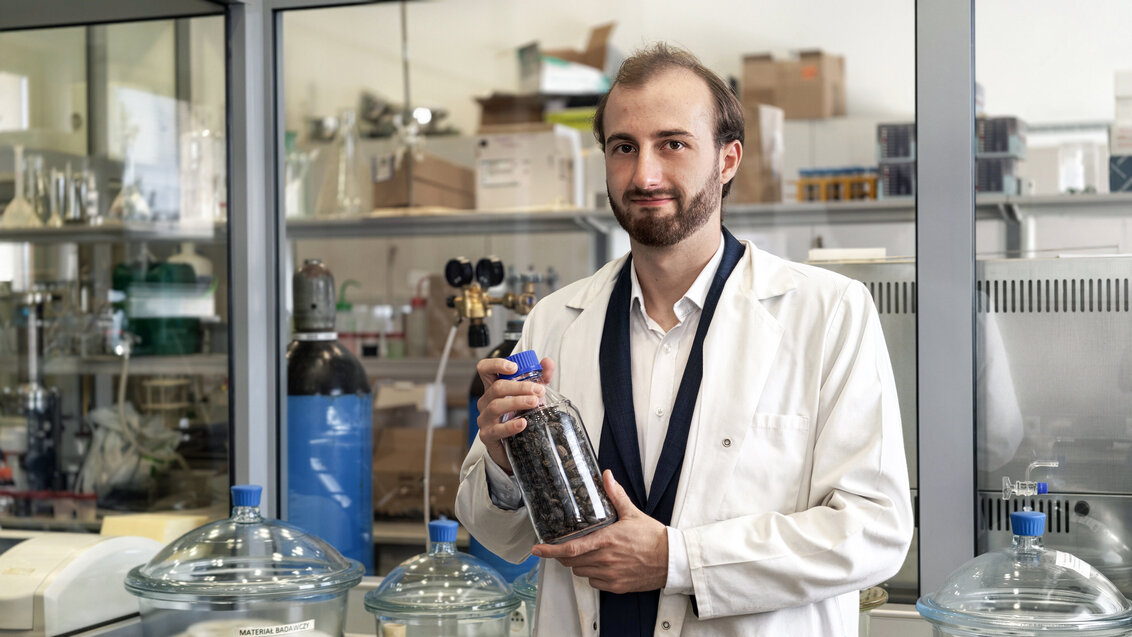
Eugeniusz Świstuń. Photograph: Marianna Cielecka
Tree pests collected in forests are typically treated as waste and are either disposed of or left to decompose naturally. An AGH University researcher sees them as a source of chitin, a valuable biopolymer with a number of industrial applications. He is currently investigating whether it can be extracted from dead insects on a large scale.
Alongside cellulose, chitin is one of the two most common biopolymers found in nature. It is a structural component of arthropods, fungi, and yeasts, as well as certain invertebrates. A derivative of chitin, chitosan, is used in industrial applications; it is obtained by removing at least more than half of the acetyl groups from chitin. Unlike chitin, it is soluble in aqueous acid solutions (chitin does not dissolve in water or most organic solvents) and highly reactive due to the presence of free amino groups.
Thanks to its chemical properties and non-toxic, biodegradable, and antimicrobial nature, chitosan has become a remarkably versatile material. It is used in medicine and pharmacy, including wound care, in water treatment and pollutant removal, in agriculture and animal husbandry, for example as a component of controlled-release fertilisers and animal feed, and in the food industry for the production of edible coatings and food preservation. Its applications also extend to textile and paper production, where it can enhance material properties and provide antibacterial protection, and to cosmetics and biotechnology, including the development of sustainable bioplastics.
An alternative to Asia-imported chitin
Due to their wide range of applications, the chitin and chitosan market is experiencing dynamic growth. Between 2016 and 2021, it averaged 15.4% per year, eventually reaching a figure of $4.2 billion. In 2023, it was already estimated at $10.3 billion, and forecasts suggest it will be nearly three times that figure by 2030. The main source of chitin for industry is the shells of prawns and crabs, a by-product of seafood processing. Consequently, the growth of this market primarily benefits countries with appropriate geographical conditions, where seafood processing generates substantial quantities of shell waste.
“Chitin and chitosan production is largely concentrated in Southeast Asian countries such as China, India, and Thailand. Producers from South America, particularly Chile, are also gaining in importance. In turn, Europe remains highly dependent on imports of this raw material. For this reason, the development of local production, including in Poland, could be an important step towards ensuring supply security. The events of recent years, from the COVID-19 pandemic to international conflicts, have highlighted the vulnerability of global supply chains to disruption. On-site production could mitigate this risk, even if it involved potentially higher costs,” says Eugeniusz Świstuń, a doctoral student at the Faculty of Geology, Geophysics and Environmental Protection.
An attempt that can rise to the challenge
As part of a project funded under PRELUDIUM 24, a programme of the Polish National Science Centre, the researcher is investigating whether insects classified as forest pests and managed by the Polish State Forests could serve as an efficient alternative source of chitin and chitosan.
Chitin is a component of the exoskeletons of insects, which protect their bodies and provide them with stability. In the past, researchers have successfully extracted these polymers from insect biomass using pupa exuviae and dead adult specimens of butterflies, bees, beetles, and houseflies. However, the use of wild forest pests for this purpose remains extremely rare, and in Poland, no such efforts have been recorded to date.
An untapped resource hidden in forests
Insects used in the research are specimens caught in pheromone traps, used by foresters to control insect populations and combat them. They usually take the form of boxes or tubes that contain a scented substance that attracts insects. Once an insect gets into the trap, there is no way out. The compounds used in the traps are carefully selected to attract only specific insect species. Therefore, they pose no threat to non-target insects, while providing the scientist with precisely selected material for his research.
What is the potential scale of this resource nationwide?
“For one of my recent articles, I carried out estimates based on field research on bark beetles. It turned out that a single pheromone trap can collect up to 1.5 kg of insects. During insect outbreaks, several such traps are usually set up per hectare, and operations often cover hundreds or thousands of hectares. Assuming the area amounts to 10,000 ha and there are two traps per hectare, this translates to approximately 30 t of insects caught. The scale of the biomass obtained in the process is significant,” claims the AGH University researcher.
Five pest species under the microscope
As part of his research, the doctoral student will investigate the feasibility of extracting chitin and chitosan from at least five species of pests responsible for significant damage to trees. These include the European spruce bark beetle, common cockchafer, spruce engraver beetle, nun moth, and sharp-dentated bark beetle.
The methods used to extract polymers from insects are largely the same as those employed in the processing of crustaceans. After being cleaned and dried, the insects are ground to a uniform particle size. The proteins, minerals, and acetyl groups are then chemically removed from the biomass to produce chitosan. Finally, the resulting polymer is decolourised to remove pigments naturally present in the insects’ bodies.
Świstuń will adopt a similar approach in his work on insects. Any differences in the process are likely to concern the amounts of reagents used and the temperatures at which the process is carried out. This is not the first time the AGH University researcher has explored this field, having previously filed a patent application for a method for extracting chitin and chitosan from forest pests.
In assessing the potential of individual insect species as sources of these polymers, the main criterion will be the amount of polymer that can be obtained from dry biomass, but this is not the only factor to be taken into account. The material received will also undergo a quality analysis.
“The key parameter in this case is the degree of deacetylation, which is assessed using methods such as FTIR [Fourier-transform infrared spectroscopy] and titration. Solubility, viscosity, and degree of crystallinity are also important factors, as they determine the suitability of chitosan for specific applications,” explains the researcher.
Effective, yet inexpensive
Following preliminary analyses, Świstuń intends to select an insect species that shows particular promise as a source of chitin and chitosan. Then he will try to optimise the sourcing process to achieve the highest possible yield of polymer that meets the required quality criteria at the lowest possible cost. The researcher’s aim is to obtain chitosan that constitutes 10% of the dry biomass with a degree of deacetylation of at least 75%.
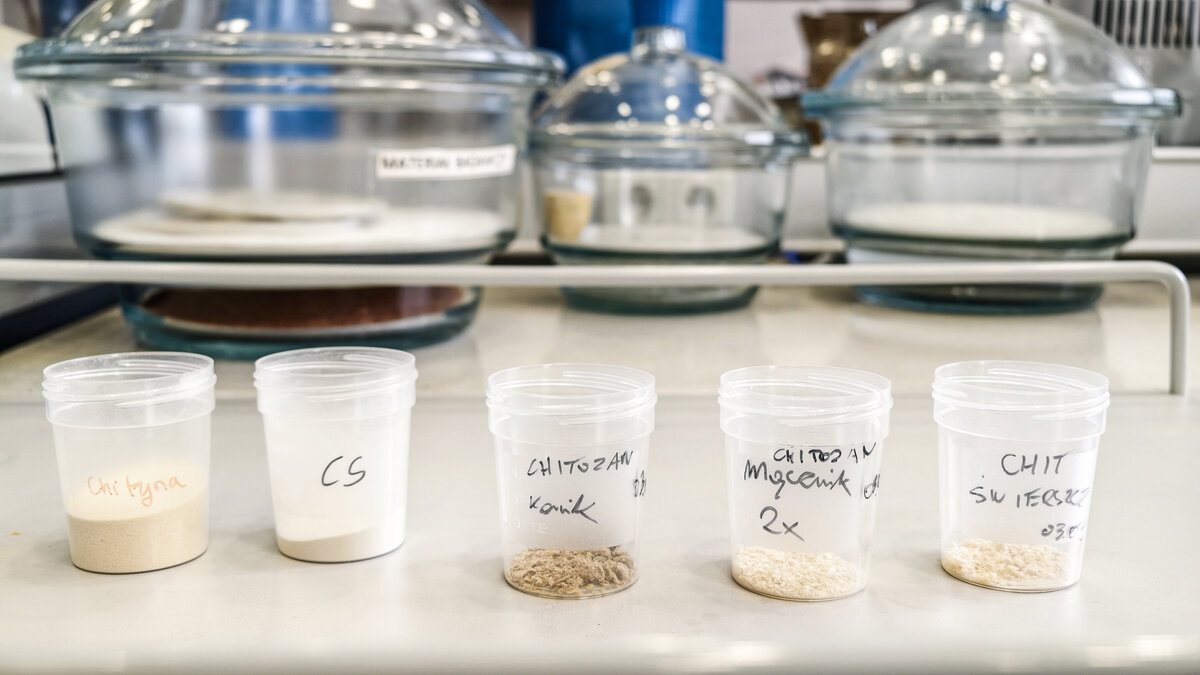
Samples of chitin and chitosan obtained from various insects. Photograph: Marianna Cielecka

Beetles and bark beetles used in the research. Photograph: Marianna Cielecka
“When producing chitin and chitosan, selecting the right process parameters is crucial. For example, we can investigate whether processes that are traditionally carried out at around 70°C can achieve similar efficiency at lower temperatures, helping to reduce energy consumption. The quantities and concentrations of the reagents used are also subject to optimisation. In the case of chitosan, this is particularly important, as production conditions affect not only costs and yield, but also material properties, such as viscosity and solubility.”
From laboratory to industry
Finally, Świstuń intends to investigate whether the process he has developed can be scaled up from the laboratory to a semi-industrial scale. To this end, a chemical reactor is being assembled at the Faculty of Geology, Geophysics, and Environmental Protection in collaboration with an external company; this will enable synthesis on a larger scale under strictly controlled conditions. A measure of success, which defines the potential for further development of the technology, will be the production of 150 g of chitosan from 0.5 to 1 kg of dry biomass.
Beyond the utilisation of dead insects that are currently treated solely as waste, the implementation of this solution in forests may offer an additional benefit. If pest species come to be regarded as a valuable resource, foresters may reduce their reliance on chemical insecticides in favour of a more frequent use of alternative population control methods. At present, many pest-management practices have an adverse environmental impact, as they often involve the application of chemicals that contaminate forest soils.
 New academic year discounts in AGH University e-Shop
  Monitoring mining and post-mining areas: AGH University part of MINERVA research project
  AGH University Rector appointed Chair of IZTECH Council
  AGH University retains its position in THE World University Rankings 2027
  Two AGH University projects with FIRST TEAM grant
  From nanoparticles to optogenetics: AGH University researcher on a path towards precise neural control
  A university shaping the future
  Web of Science AI Research Assistant – trial access

