News

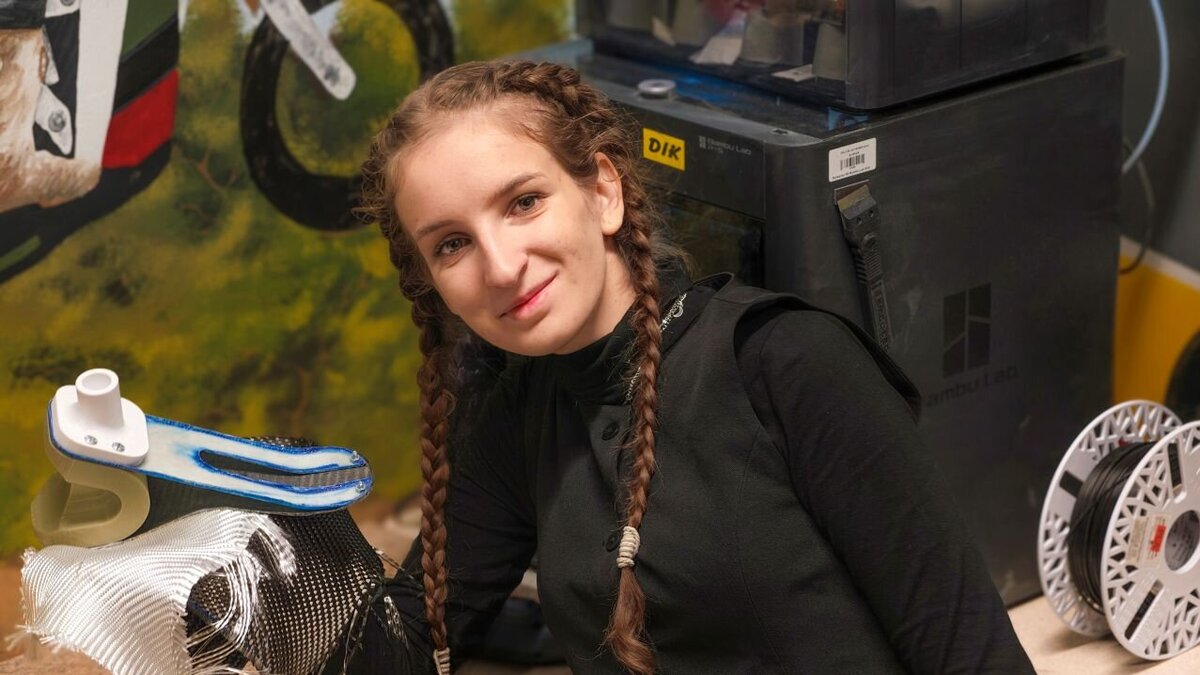
Agata Skalska. Photograph: Marianna Cielecka
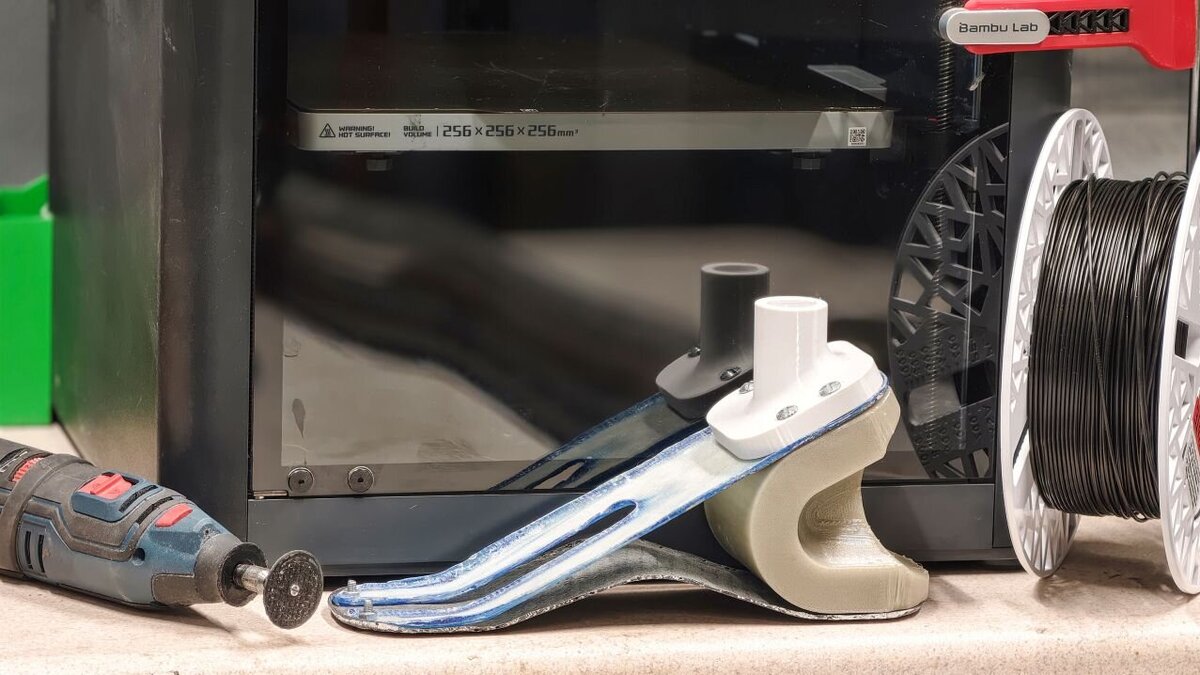
Agata Skalska, a Mechatronic Engineering student at the Faculty of Mechanical Engineering and Robotics, has developed an innovative lower-limb prosthesis. Unlike conventional designs, the prosthesis can be turned sideways, helping users maintain greater stability and move more safely.
“The idea itself came about a few years ago. I have always been interested in sports and engineering, so it was the perfect combination for me. My prosthesis was designed for people with above-knee amputation and focuses on the ankle joint. In most commercially available solutions, this joint is fixed, which significantly impedes day-to-day functioning and mobility. In my prosthesis, the ankle joint module allows movement in the frontal plane, side to side. As a general rule, when we step onto uneven ground, such as a stone, our ankle twists to the side, helping us maintain stability. I wanted to explore whether my solution would allow users to maintain balance in a similar way,” explains Agata Skalska.
The student was also inspired by Cybathlon, an international competition for people with disabilities that challenges participants to complete tasks using prototype prosthetic limbs. One of the Cybathlon events, Wobbly Steps, requires competitors to walk across unstable discs that challenge their balance and assess the stability of their prosthetic limbs on an unstable surface.
The first stage of the project was a review of anatomical atlases, which was followed by the creation of a preliminary design, a strength analysis and the selection of materials for the prototype. As Agata Skalska points out, the computational part of the project posed the greatest challenge.
The prosthesis consists of four parts: the sole, the upper section of the foot, the heel module, and the adapter.
The sole is made of carbon fibre, which is quite stiff, light and durable. The next part was made from a more flexible fibreglass. To create the heel, the student used TPU, a material similar to flexible rubber (when bent, it returns to its original shape). As regards the manufacturing process, a mould had to be made for the composite components, followed by vacuum lamination with epoxy resin, whereas the heel was 3D-printed. The upper section of the prosthetic foot features a longitudinal slit that allows it to move independently. The design enables the prosthesis to adapt more effectively to terrain, improving the user’s stability.
The prototype was tested under loads of 50 kg and 100 kg and met the designer’s expectations. As Skalska points out, future iterations could be tailored to different user characteristics, including body weight, as each prosthesis should be adapted to the individual needs of its wearer.
The project formed the basis of the student’s engineering thesis. The supervisor of the thesis was Professor Krzysztof Mendrok. Agata Skalska is currently studying 3D Printing of Metallic Materials at the Faculty of Metals Engineering and Industrial Computer Science, while also pursuing a Master’s degree at the Faculty of Mechanical Engineering and Robotics.
Photograph: Marianna Cielecka
Photograph: Marianna Cielecka
 Psychological support
 AGH University Graduation Ceremony 2026
 NCN grants to support the development of international research cooperation
 Perła solar car named best engineering project in KoKoN student competition
 First edition of IDUB at AGH University. A video recap
 AGH University joins the Magalhães Network Steering Committee
 A message of condolence


