News

AGH Space Systems, a team of students from the AGH University, has just won the Australian Rover Challenge 2025 (ARCh), that took place on 27–30 March 2025 at the University of Adelaide. The student research club obtained 421.6 points out of 500. In the final stage of the challenge, the students defeated 14 teams from all over the world, positioning themselves as leaders in the international community of student constructors and creators of space technologies. The debut in the Australian competition has brought the team a well-deserved win.
“The win of AGH Space Systems in the Australian Rover Challenge 2025 is another milestone in the history of Polish space technology. The team’s success not only translates to the recognition of outstanding skills of AGH University students, but is also an example of innovativeness that may inspire future generations of engineers and scientists,” emphasises Professor Jerzy Lis, AGH University Rector.
The victory in a challenge where students from Australia and the entire world compete in a lunar mission, using rovers they have designed and constructed themselves, is a perfect example of the growing role of Poland in the international robotics and space exploration community. Not only is it a reason to be proud but also it should be a source of inspiration to even further develop space technologies. During the challenge, the team had to face four demanding tasks: Post-Landing Task, Space Resources Task, Excavation & Construction Task, and Mapping & Autonomous Task.
“ARCh was an unprecedented challenge in some ways. The tasks often required the use of a completely new set of skills, both of the rover and of our operators. The months of hard work have paid off, as each member of the team has contributed to this success,” highlight the students who participated in the robotic rivalry.
The Australian Rover Challenge demands from the participants to handle a variety of complicated tasks, and this year they were particularly troublesome. One of key moments in the competition was the Mapping & Autonomous Task. The AGH Space Systems team faced UQ Space from the University of Queensland, a team that had a minimal advantage, exactly four points. Nevertheless, AGH Space Systems emerged victorious, and their rover, Kalman, successfully identified and mapped all key objects, moving on the field with high precision. The team’s presentation was highly praised by the jury, who recognised the advanced autonomous navigation algorithms and data analysis techniques.
In the Space Resources Task, Kalman demonstrated its ability to extract resources from simulated lunar regolith with precision and to operate the manipulator efficiently.
In the Excavation & Construction Task, AGH Space Systems presented their skills in the construction and assembly of lunar infrastructure.
The Australian Rover Challenge is an annual robotics competition organised by the University of Adelaide, where university students from around the globe compete in a simulated mission on the Moon. The competition involves a range of tasks related to navigation, extraction of resources, and construction of infrastructure on a simulated lunar surface, with the aim of testing participants' skills in robotic and autonomous technologies.
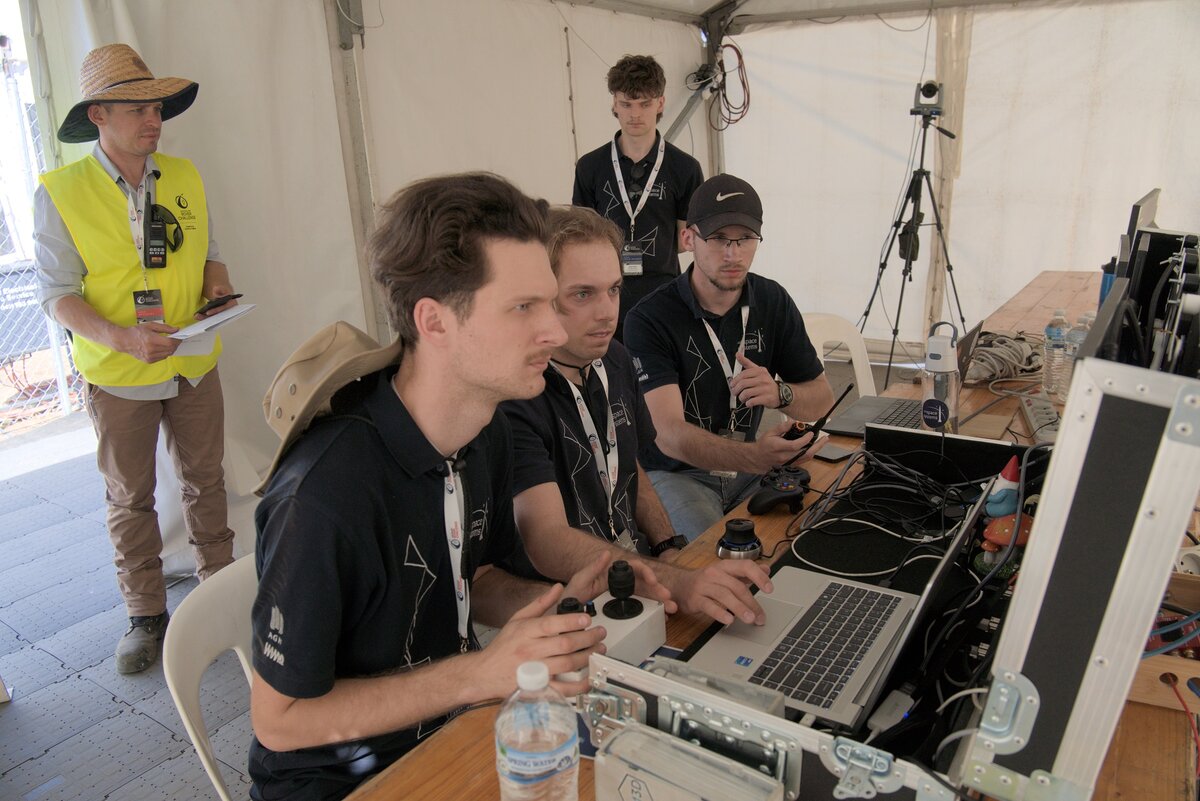
Photograph: Kamila Kopacz

Photograph: Kamila Kopacz

Photograph: Kamila Kopacz
 AGH Solar Plane comes fifth in SUAS 2026
  The future of technical universities and quality of education in focus at AGH University
  Academia and industry unite for AI: establishment of CESAR
  AGH University in 2026 Global Ranking of Academic Subjects
  Polish Press Agency launches Scientific Think Tank with AGH University
  Can tree pests yield biopolymers? AGH University researcher seeks sustainable solution

